


|
The research output of Qatar University has doubled over the past two years along with significant increase in research budget, a senior official said yesterday. During this period, QU also established a state-of-the-art research complex and seven new research centres of excellence. |
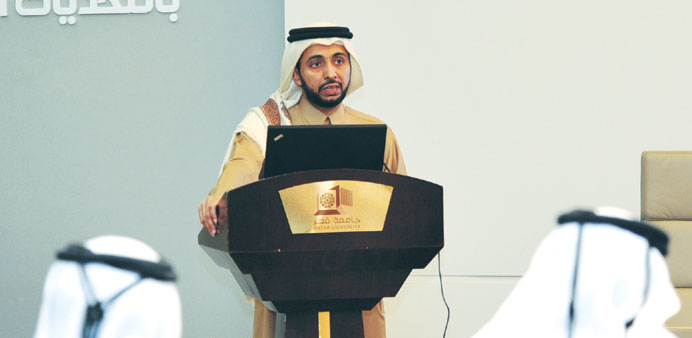
QU vice president for research Dr Hassan al-Derham said the national university continues to advance its research plans as outlined in its strategic plan to become a leader in research in the region and to contribute to advancing a research culture in Qatar.
“QU’s research endeavours have emerged from its vision to be a model national university in the region, recognised for high-quality education and research and for being a leader of economic and social development,” he explained.
The new research centres are Qatar Road Safety Studies Centre (QRSSC), Knowledge Intelligence Networked Data and Interdisciplinary Research (KINDI), Gulf Studies Centre, Centre for Sustainable Development, Humanities and Social Science Research Centre, Animal Laboratory Research Centre, and Entrepreneurship Centre.
The new centres join the university’s long-established Centre for Advanced Materials (CAM), Central Laboratories Unit (CLU), Environmental Studies Centre (ESC), Gas Processing Centre (GPC), Qatar Mobility Innovations Centre (QMIC), and Social and Economic Survey Research Institute (SESRI).
Dr al-Derham stressed that these autonomous research units will strive to make an impact on a global scale. “The university plans to utilise its findings to amass an intellectual reservoir that will establish a strong knowledge-based economy emerging from QNV 2030.”
The official pointed out that the new centres are the first in Qatar and reflect the responsibility and commitment of the university to support research that is responsive to national needs.
“They are also in line with our new five-year research agenda which will see interdisciplinary research projects centered on four areas of excellence: Energy, Environment and Resource Sustainability; Social Change and Identity; Population, Health and Wellness; and Information, Communication and Technologies (ICT).”
Dr al-Derham said the new 25,000sq m research complex was considered an important initiative for promoting QU’s research endeavours. It consists of a number of research labs, auditoriums, administrative offices, research blocks and an animal house.
The efforts to launch more graduate studies is a beneficial and efficient way to promote research endeavours and hence launched two PhD programmes to add to the existing 19 Masters, 4 Diplomas, and a PharmD programme.
“QU continues to be top winner in the award cycles of the National Priorities Research Programme (NPRP) and the Undergraduate Research Experience Programme under the Qatar National Research Fund. In the sixth NPRP cycle, QU researchers won 63 awards out of a total of 137 of its submitted proposals which translates to about 46% of the total awarded proposals - the highest among awarded institutes.”
In research publication, QU’s output has increased considerably. In 2007, 104 research findings and papers were published in international scientific magazines while in 2012, the number went up to 302.
“It is estimated that during 2013, more than 380 were published in prestigious international scientific magazines,” Dr al-Derham said while commending the role of the faculty in promoting a research culture in the university.