


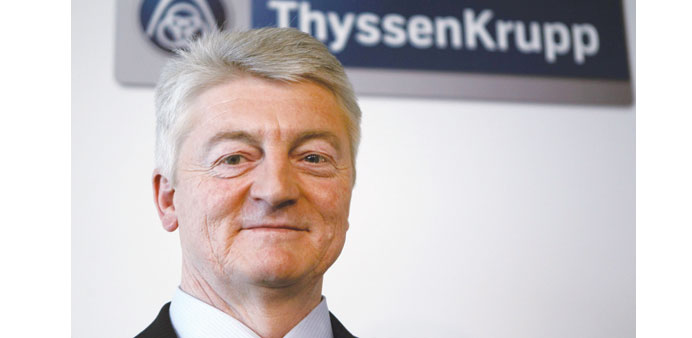
ThyssenKrupp CEO Heinrich Hiesinger posing during the company’s annual news conference at their headquarters in Essen (file). At an annual meeting on Friday, the former Siemens man will face tough questions from shareholders who, for a second year, have received no dividend.
Reuters/Frankfurt
Three years after taking the helm at ThyssenKrupp, Heinrich Hiesinger is running out of time to implement his ambitious plan to retool the 200-year-old German steelmaker as a high-tech engineering conglomerate.
Setbacks in selling weak assets — as well as costly price-fixing scandals he inherited — have made Hiesinger’s promises of sweeping transformation look optimistic. At an annual meeting on Friday, the former Siemens man will face tough questions from shareholders who, for a second year, have received no dividend. “Some thought that he was the guy who can restructure ThyssenKrupp and move it forward. But he hasn’t really achieved that yet,” said Joerg Schneider, a fund manager at Union Investment in Frankfurt. “He set the expectations too high.”
Adding to pressure on Hiesinger are small but significant shifts in the group’s ownership since the last AGM. The family trust, which long shielded managers from predators, has seen its holding diluted below a blocking 25%. Meanwhile, activist Swedish fund Cevian has built up an 11% stake.
Needing cash to expand higher-margin lines, such as elevators and high-performance car parts, Hiesinger has already sold assets accounting for a quarter of group sales. Yet delays and other problems have sparked speculation — which the CEO has consistently rejected — that he might yet pull out of steelmaking altogether, ending two centuries of Krupp tradition.
A senior manager who has worked with the 53-year-old electrical engineer told Reuters that sentiment would play little role when the CEO determines what must be sold. “There are,” he said, “no sacred cows for Hiesinger.”
Despite a 40% fall in the share price since he took over, many investors say they are keeping faith in him, for now. “I do believe that Hiesinger can still turn things around,” said Schneider at Union Investment. “But he needs to show shareholders and employees a clear path so they can finally see a light at the end of the tunnel.”
Public professions of confidence in Hiesinger’s strategy have also come from Cevian, whose founding partner Christer Gardell was dubbed “The Butcher” in Sweden for pushing aggressively for restructurings of underperforming firms. The investment group has quadrupled its stake in ThyssenKrupp since the middle of last year, giving it a significant voice at the AGM.
There has also been change at the Krupp Foundation. The last family owner, jailed but later pardoned for his role in the Nazi war effort, left his fortune to the trust to fund philanthropy.
His confidant Berthold Beitz oversaw the charity’s influence on the group for decades, before and after the 1999 merger with Thyssen. Beitz’s death last July at the age of 99 could lead to shifts in its stance.
Last month, by not participating in a capital increase, the Foundation let its stake slip below the 25% that gave it a blocking minority at the company’s AGMs. The stake now stands at 23%, still a level that gives it great sway over decisions which require the support of 75% of votes cast.
The scale of difficulties since he won support for his restructuring plan in 2011 underlines how much there is still to do for Hiesinger, whose contract is up in September next year.
Once synonymous with the rise of Germany’s industrial and military might, producing munitions, tanks and big guns from its Ruhr valley base, today’s ThyssenKrupp is a diversified global conglomerate making products ranging from bulk steel to elevators, automotive parts, fertiliser plants and warships.
When Hiesinger took over, the group appeared to be in decent shape, with most of its businesses posting profits. But as he started shaking it up, shifting the group away from the volatile steel market, lurking problems came to light. ThyssenKrupp has now posted three straight years of losses and racked up debts.
Its most profitable units are elevators, buoyed by a construction boom in China, and industrial solutions, where the US shale gas boom has driven demand for petrochemical plants.
Hiesinger has sold off units with at least €10bn ($13.6bn) of annual sales — a quarter of group turnover.
But two of the biggest items on his to-do list have become major headaches — the sales of stainless steel business Inoxum and the loss-making company Steel Americas, comprising a steel mill in Brazil and a processing plant in Alabama.