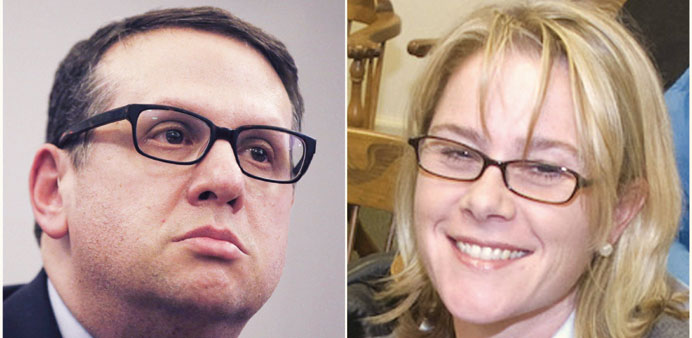
A combination photo shows former Port Authority of New York executive David Wildstein, at a hearing in Trenton, New Jersey, and Bridget Anne Kelly, deputy chief of staff of New Jersey Governor Chris Christie.
Reuters/Trenton, New Jersey
Documents related to the bridge closure scandal engulfing New Jersey Governor Chris Christie revealed on Friday that authorities were deeply divided about the shutdown, with one warning it was illegal and risking people’s lives.
More than 1,000 pages of anxiously awaited documents subpoenaed by New Jersey lawmakers investigating the massive, four-day traffic jam on the George Washington bridge were made public after revelations that Christie’s staff appeared to have orchestrated the closure as political payback.
Christie, seen as a likely contender for the White House in 2016, has said he knew nothing about the plan until damaging e-mails from his staff were revealed on Wednesday. He fired a close aide and publicly apologised for the fiasco.
The documents, many subpoenaed from former Port Authority executive David Wildstein, cast new light on the turmoil within the Port Authority of New York and New Jersey, the agency overseeing the nation’s busiest bridge.
On the fourth day of the shutdown, Patrick Foye, executive director of the Port Authority, lashed out in an e-mail to executives, including Port Authority Chairman David Samson, and ordered the lanes reopened.
“I believe this hasty and ill-advised decision violates Federal Law and the laws of both states,” Foye said in the e-mail.
“I pray that no life has been lost or trip of a hospital- or hospice-bound patient delayed,” said Foye of the traffic jam that delayed ambulances, including one called for a 91-year-old woman who later died.
Assemblyman John Wisniewski, a Democrat who chairs the Transportation Committee, said the documents raise more questions than they answer about whether Christie knew about the traffic tie-up.
“Included in these documents is a reference to what appears to be a meeting between Port Authority Chairman David Samson and the governor one week before Bridget Kelly issued the order to cause ‘traffic problems’ in Fort Lee,” Wisniewski said in a statement.
“By submitting these documents, Mr. Wildstein is telling us they are related to the lane closures in some way. The question that demands answering is - how?”
The documents show chaos and anger, but fail to clear up whether the epic tie-up was the result of what Christie said may have been a Port Authority traffic study.
In a Sept. 6 e-mail, Port Authority executive Daniel Jacobs, general manager of transportation, asked Gerard Quelch, in charge of planning and operations: “What is driving this?”
Quelch responded: “That is my question as well. A single toll operation invites potential disaster. It seems like we are punishing all for the sake of a few.”
What is clear is that Port Authority police and bridge authorities had little advance notice of the shutdown, which they warned would paralyse Fort Lee, where three major roadways converge in an approach to the bridge.
“The ‘test’ was a monumental failure. Fort Lee is not happy,” Bob Durando, director of the bridge, wrote in an e-mail to a Port Authority traffic engineer.
There also appears to have been a concerted effort to keep the matter quiet. On the day he ordered the lanes reopened, Foye in an email told Wildstein’s boss, Bill Baroni: “We are going to fix this fiasco.”
Baroni wrote back: “I’m on my way to the office to discuss. There can be no public discourse.”
Foye’s response: “Bill that’s precisely the problem: There has been no public discourse on this.”
Christie said he was “blindsided” by the revelation that Kelly called for trouble at the commuter choke point, apparently to retaliate against the Democratic mayor of Fort Lee for not having endorsed Christie’s re-election campaign.