


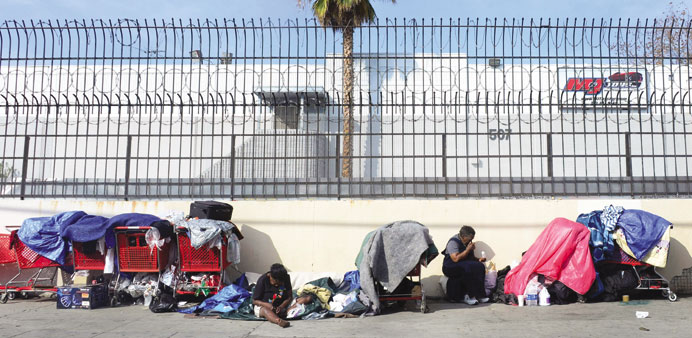
Homeless women sit amid their belongings on a street in downtown Los Angeles, on January 8. Poverty in the world’s largest economy remains far from being eradicated 50 years after President Lyndon Johnson declared a war on poverty in America in his first State of the Union address on this date in 1964, with a US Census Bureau report revealing on January 7 that nearly one in three Americans experienced poverty for at least two months during the global recession between 2009 and 2011. And in 2012, poverty affected some 47mn Americans, including 13mn children.
By Ann Stevens and Marianne Page/Los Angeles Times/MCT
January 8 marked the 50th anniversary of legislation launching America’s War on Poverty. The story of that war is often told with a sort of reverse Hollywood ending: oversimplified and wrapped up neatly as a failure. No one can claim that the war on poverty has been won, but the failure narrative is just as wrong. The real story with some fundamental facts highlighted is more complex than simple wins and losses, and long overdue.
First, careful studies confirm that many of the safety net programmes initiated with the War on Poverty, such as Head Start, WIC and food stamps (now called SNAP), make a big difference in the lives of the poor. Recent research by economists Hilary Hoynes, Douglas Almond and Diane Schanzenbach shows, for example, that the introduction of the food stamp programme improved infant health, especially in high poverty areas where participation rates were highest. Similar benefits have been found for WIC, and for cash-based anti-poverty programmes. Gordon Dahl and Lance Lochner have shown that increases in the size of the earned income tax credit are associated with improvements in low-income children’s achievement test scores.
These safety net benefits go unrecognised because our official poverty statistics do not measure such noncash or after-tax benefits, nor do they track real outcomes, like improvements in health or education. But the benefits are there, and they need to be taken into account, especially when cuts are being proposed.
Second, you can’t evaluate the effects of the War on Poverty without recognising that bipartisan welfare reform efforts in 1996 and expansions in the earned income tax credit have shifted the battleground toward policies that make employment a condition of most assistance for able-bodied adults. Cash assistance under the Temporary Assistance for Needy Families programme fell from nearly 70% of the programme’s total budget in 1997 to less than 30% in recent years. Now, the programme’s dollars are used for training or work support services rather than for direct cash payments to low-income single parents. Over the same period, inflation-adjusted spending on the earned income tax credit, which requires individuals to have substantial amounts of earned income, rose from $20bn in 1992 to more than triple that amount today.
Many consider this shift toward work to be a victory in itself, but it has to be considered against some hard facts about changes in the labour market since the War on Poverty began. The real value of wages for full-time male workers at the bottom of the earning distribution fell by more than 15% between the 1970s and the mid-1990s, rebounding only partially in the subsequent two decades. The federal minimum wage is worth only about three-quarters of its value in 1968. Given the shift toward requiring work and falling wages, the fact that poverty in the US has not risen dramatically may be the more important victory.
Third, there is a growing understanding of why and how safety net programmes can reduce poverty across generations. Biological and social scientists have demonstrated that deprivation, chronic stress and income volatility can change the brain and the body in ways that reduce both children’s and adults’ ability to focus, learn and succeed. This begins to explain why safety net programmes not only improve immediate well-being but, by improving the conditions under which children develop, increase income and well-being in the next generation.
The same researchers who studied the immediate effects of food stamps on infant health have also shown that these initial benefits appear to last for decades. The first groups of children made eligible for food stamps were less likely, as adults, to suffer from a troubling combination of diabetes, obesity and high blood pressure and were more likely to become economically self-sufficient as adults - graduating from high school, working and not receiving welfare benefits - than children from counties where the food stamp programme began after their early childhood years.
The Great Recession and its aftermath have been accompanied by reductions in funding for classic War on Poverty programmes: cash assistance, food stamps, support services and public education. After 50 years and an official national poverty rate that has barely budged, many have suggested that we should abandon the war on poverty and redistribute public dollars to other pressing needs. We could not make a bigger mistake. These programmes produce real, positive effects.
By misrepresenting the War on Poverty as a failed effort, we may make ourselves feel better about these cuts, but the evidence shows that a smaller safety net will have negative repercussions even beyond those we might have imagined 50 years ago.