


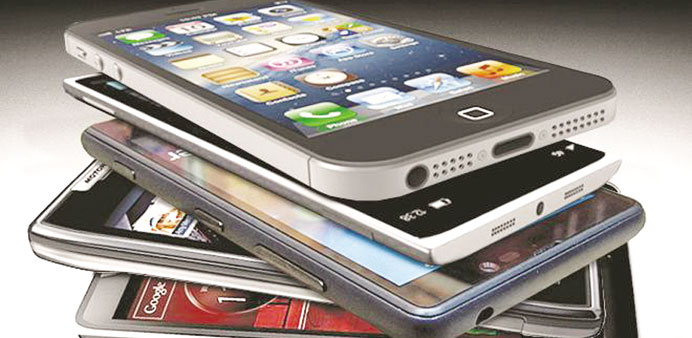
Not only are women keeping pace with men when it comes to smartphone use, they are actually using tablets more often.
By Pratap John/Chief Business Reporter
Driven by advanced new devices such as tablets, computer hardware sales in Qatar are expected to reach about QR4bn in 2017, a new report has shown.
According to Business Monitor International (BMI), the country’s IT market benefits from “strong private consumption” from a “relatively wealthy population and high public spending”.
Computer hardware sales in the country totalled QR2.75bn in 2013, the report said.
However, the local IT market is held back by a small population, which “does not guarantee” high-volume sales for most consumer products.
“That said, there are significant growth opportunities in the public and private sectors as the government takes steps to diversify the economy and businesses adopt new solutions to improve operational efficiencies,” BMI said.
Qatar’s IT market outlook, the report said, is boosted by government policy under ict QATAR’s ICT-2015 strategy, and the government’s push to develop smart cities in the country.
Ambitious government investments in network infrastructure, as well as e-government and the promotion of smart systems and modernisation of enterprises will see growth not only in traditional applications but also innovative IT systems and infrastructure, the report said. This outlook extends beyond the five-year forecast period, with the decision to award Qatar the 2022 FIFA World Cup likely to support investments for several years beyond 2017, BMI said.
In the last “Qatar ICT landscape” report, ictQATAR said cumbersome, stationary desktop computers appear to be on the way out in the country. Data shows that mainstream residents—especially those who are young and well educated—are increasingly adopting more advanced devices such as smartphones and tablets that can be used on the go.
Interestingly, gender discrepancies are much less pronounced with these devices: not only are women keeping pace with men when it comes to smartphone use, they are actually using tablets more often.
Numerous advances continue to fuel smartphone penetration in Qatar, including the availability of a broader range of models and improved and expanded mobile broadband coverage and services.
Above all, it seems that people increasingly want or need to access the Internet—with its boundless information and communication tools—in a more immediate, on-the-go fashion.
As of early 2013, 69.3% of all households owned a smartphone, as did 55% of mainstream individuals. This included relatively similar numbers of men and women.
Along with the penetration of smartphones, easy-to-use, portable, next-generation tablet computers is also being widely used in Qatar, with a quarter of mainstream households owning at least one of these devices.
Significantly, 11% of women in the mainstream population use tablet computers, versus only 8% of men—one of the only ICT categories where women have higher penetration rates (early 2013 data).
Thanks in large part to these handy new devices; a growing number of people in Qatar are accessing the Internet on the go, away from a desk or some other stationary location. In fact, less than half of mainstream Internet users now use a desktop computer to go online, with 87% using laptops, 55% using smartphones, and 14% using tablet computers to log on, the BMI report said.