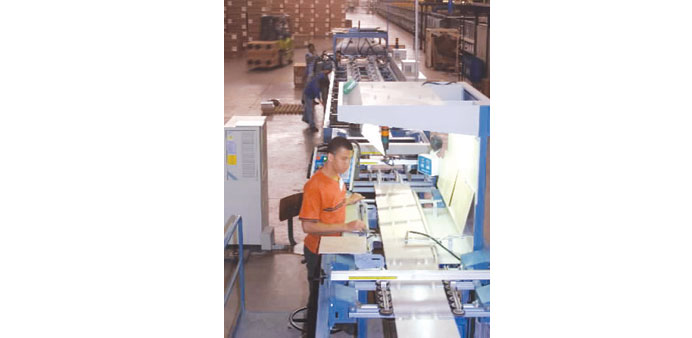
A ceramic factory worker operates machinery at Nardini Ceramica, a maker of ceramic kitchenware, in Santa Gertrudes, Brazil (file). Brazil industrial output fell 0.2% in November after rising 0.6% in October, the national statistics agency said yesterday.
Bloomberg/Rio de Janeiro
Brazil’s industrial production in November dropped less than economists forecast, buoyed by pharmaceuticals, fuel refining and office machinery. Swap rates rose.
Industrial output fell 0.2% from the previous month after rising 0.6% in October, the national statistics agency said yesterdaty in Rio de Janeiro. That was better than every forecast from 40 economists surveyed by Bloomberg, whose median estimate was for a 1.1% decline. Production unexpectedly rose 0.4% from the year before, better than the 0.8% drop forecast by economists.
“It’s not quite as bad as people thought it would be,” Neil Shearing, chief emerging markets economist at Capital Economics Ltd, said by phone from London. “But this doesn’t change the bigger picture that the industrial sector is struggling still.”
Brazil’s economy in the third quarter contracted for the first time since 2009 even as President Dilma Rousseff’s government cut taxes to boost consumption and production.
The combination of fiscal deterioration and slow growth has prompted ratings companies to revise downward their outlooks for the credit rating of Latin America’s largest nation.
The central bank will raise rates for a seventh straight time next week to rein in inflation, according to a Bloomberg survey. Swap rates on the contract maturing in January 2015, the most traded in Sao Paulo today, rose two basis points, or 0.02 percentage point, to 10.55% at 10:11 a.m. local time. The real weakened 0.2% to 2.3775 per US dollar.
Rousseff’s administration is reducing tax cuts on appliances such as refrigerators and stoves after the government posted its lowest primary budget surplus in 16 years. The government on Jan. 1 began rolling back tax breaks for the purchase of vehicles. Finance Minister Guido Mantega told reporters in Brasilia January 3 that the central government’s primary surplus was 75bn reais ($32bn), beating its target. The primary surplus excludes payments on interest.
Production of consumer goods rose 0.5%, the statistics agency said today. Capital goods output fell 2.6%. Of the 27 areas studied by the national statistics institute, 14 industries marked declines in November, including a 3.2% drop in the automobile sector.
The smaller-than-expected fall was largely due to production of intermediate goods, which marked their fourth consecutive increase, according to Thais Zara, chief economist at Rosenberg Associados. Intermediate goods rose 1.2% in November, according to the statistics institute.
While the data beat expectations, the diffusion index signals weakness in the sector, according to Jankiel Santos, chief economist at Banco Espirito Santo de Investimento.
The index, which measures the% of products whose output is growing, fell to 23.2% in November from 73.9% the prior month, according to the statistics institute. Brazil’s central bank has raised its benchmark Selic rate by 50 basis points, or 0.5 percentage point, in five straight meetings to 10%, following a quarter-point increase in April. Inflation twice last year breached the upper limit of the 2.5% to 6.5% target range before slowing to 5.77% in November. The central bank targets 4.5% inflation.
Of 36 economists surveyed by Bloomberg, 25 forecast a 25 basis-point increase at the central bank’s monetary policy meeting next week, with the remaining analysts calling for a half-percentage point increase.
Data reinforce the likelihood the central bank will increase borrowing costs beyond 25 basis points, according to Zara, who forecasts three consecutive quarter-point increases.
Analysts polled by the central bank January 3 reduced their 2014 growth forecast to 1.95% from 2% the prior week. The roughly 100 economists forecast the central bank will boost the Selic by an additional 50 basis points this year.