


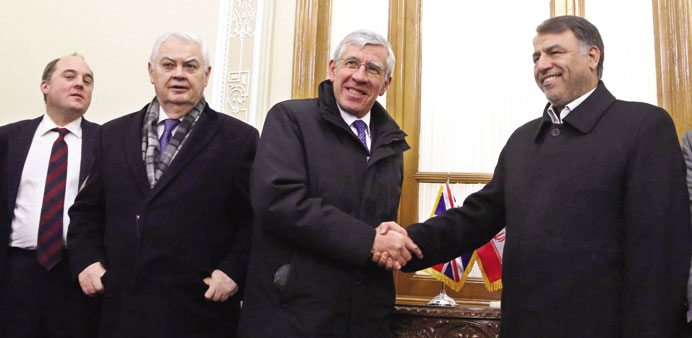
Former British foreign secretary Jack Straw shakes hands with Iranian MP Abbasali Mansouri in Tehran yesterday.
Iran’s President Hassan Rohani defended yesterday a landmark nuclear deal with world powers that promises modest sanctions relief, saying his government did not fear “the few” domestic critics.
Rohani’s defence came after repeated criticism by hardliners in parliament and the powerful Revolutionary Guards of the deal clinched in November that also requires Iran to curb temporarily parts of its nuclear drive.
“The initial agreement with the six major powers on the nuclear issue was not a simple task but very difficult and complicated,” Rohani said in remarks broadcast live on state television.
“It required brave decision-making ... We should not and do not fear the fuss made by the few people or a small percentage” criticising the deal, he said.
The critics however have been united in questioning what Iran gains from the deal, under which it agreed to roll back parts of its nuclear drive for six months in exchange for modest sanctions relief and a promise by Western powers not to impose new sanctions.
They say fewer concessions could have been made by the nuclear negotiating team, led by Foreign Minister Mohamed Javad Zarif.
In recent weeks, hardliners in the conservative-dominated parliament have sought to form a committee to supervise the negotiating process but to no avail.
Government officials say the nuclear dossier will remain under direct control of the Supreme National Security Council and that final decisions still rest with Iran’s ultimate authority, Supreme Leader Ayatollah Ali Khamenei.
Rohani yesterday insisted he has the full support of Khamenei.
“In all important and sensitive steps along the way, the supreme leader has backed the government and its policies,” he said. “Iran is in a special situation that needs to be replaced by normalcy.”
Iran’s economy has been hard hit by international sanctions, while the vital oil exports have been more than halved by US and European embargoes.
In Tehran, lawmakers meanwhile are readying a bill that would oblige the government to enrich uranium to 60% if Iran is hit by new sanctions.
Under the nuclear deal in Geneva, Iran will limit its enrichment of uranium to 5%. Higher level purities of above 90% could provide fissile material for nuclear weapons.
The deal—which is yet to come into force—is aimed at creating a window of diplomatic opportunity for Iran and the P5+1 group of world powers, comprising the United States, Britain, France, China and Russia plus Germany.
The sides are engaged in negotiations to find a lasting solution to the decade-long standoff over Iran’s nuclear activities, which Western powers suspect mask military objectives despite repeated denials by Tehran.
Talks to remove remaining obstacles before the deal is implemented will resume in Geneva tomorrow.
The two-day meeting will focus on “one or two remaining issues pending a political decision” before the deal can be put into effect, Iran’s foreign ministry spokeswoman Marzieh Afkham told reporters yesterday.
The talks will bring together Iran’s deputy foreign minister Abbas Araqchi and Helga Schmid, the deputy to EU foreign policy chief Catherine Ashton, the official Irna news agency reported.
British MPs meet Zarif in Iran to boost diplomatic ties
A British parliamentary delegation led by former foreign secretary Jack Straw met Iranian Foreign Minister Mohamed Javad Zarif yesterday at the start of the first such visit in years, Iranian state television reported.
Long-strained ties between the two countries have warmed since the relatively moderate Hassan Rohani was elected Iran’s president in June.
In December, a new non-resident charge d’affaires made Britain’s first diplomatic visit to Iran since London downgraded ties after hardliners stormed its embassy in 2011. The two countries’ respective embassies remain closed, however.
Iranian media said the delegation would also meet parliamentary speaker Ali Larijani and the head of the parliament’s National Security and Foreign Policy Committee, Alaeddin Boroujerdi.
Rohani’s election has also signalled detente on the thorny issue of Iran’s sensitive nuclear programme; six world powers including Britain agreed an outline deal in November that will curb the programme in return for an easing of economic sanctions.
The other members of the British delegation are former finance minister Norman Lamont, Conservative member of parliament Ben Wallace and Labour lawmaker Jeremy Corbyn.
Straw has strongly advocated rapprochement with Tehran since Rohani took office in August, arguing that his presidency offers an opportunity to resolve concerns over Iran’s nuclear ambitions that the West must seize.
Straw was involved in intensive negotiations with Rohani in the early 2000s when the two men were respectively foreign minister and chief nuclear negotiator.
Those talks led to Iran agreeing to suspend its enrichment of uranium and open its nuclear facilities to spot checks. The deal was later overturned by parliament.