


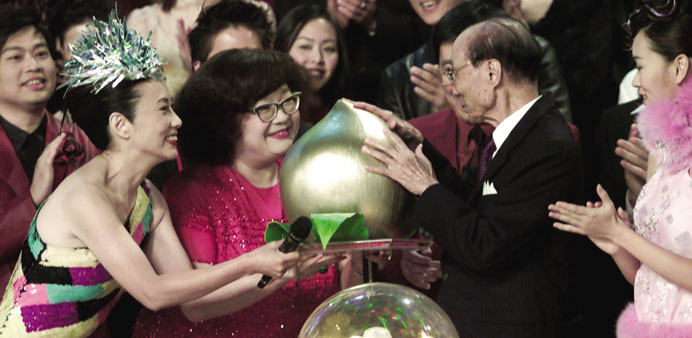
This November 19, 2001 file picture shows Shaw receiving a birthday present of a golden peach from Hong Kong actresses (late) Lydia Shum (second left) and Liza Wang (left) during the ‘TVB 34th
Anniversary Special’ in Hong Kong.
Hong Kong media mogul Sir Run Run Shaw, who created an empire in Asia spanning movies to television, died yesterday at the age of 106, his company said.
Shaw died peacefully at his home in Hong Kong, surrounded by his family, his company, Television Broadcasts Limited (TVB), said in a statement.
One of Hong Kong cinema’s defining figures, Shaw popularised Chinese kungfu films in the West and helped turn the former British colony into a “Hollywood East” over an 80-year career.
He set up Hong Kong’s biggest free-to-air television operator, TVB, in 1967 and served as its executive chairman until 2011, helping to shape the city’s media culture.
“Thanks to his wise leadership, TVB has its status today after 46 years,” said TVB executive chairman Norman Leung.
A passionate film-lover from an early age, legend has it that Shaw first cut his teeth in the business by distributing film reels on a bicycle to rural cinemas in Singapore and Malaysia, giving poignancy to his name “Run Run”.
He started out helping his elder brothers Runje, Runde and Runme set up a film studio in Shanghai in 1925. The brothers later moved into Hong Kong – making and distributing films to a chain of around 100 cinemas spread across other Asian markets such as Singapore, Malaysia, and Thailand.
Shaw eventually split from his brothers to set up his own studio in the 1950s dubbed the dream factory, which ushered in a golden era of Hong Kong film-making.
Shaw is also remembered as a philanthropist, especially fondly in mainland China, where he donated 4.5bn yuan ($744mn) over the years, mostly to education, according to Hong Kong media reports.
Many school buildings in the mainland are named after him.
Chinese Internet users paid tribute to Shaw yesterday, saying wealthy Chinese should follow his example.
“People say the Chinese hate rich people, but why do so many Chinese mourn Run Run Shaw?” wrote one user of Sina Weibo, China’s Twitter-like microblog site. “It’s because his name is on school buildings everywhere, compared to so many Chinese moguls who splurge on yachts, limousines and weddings.”
The Shaw studio produced about a thousand titles, including melodramas, historical epics and kungfu classics like The One-armed Swordsman – helping to redefine genres and lure new cinema-goers not only in Asia, but in the West.
Shaw also invested in a number of co-productions, most notably the Ridley Scott classic, Blade Runner, in 1982.
The studio also pioneered so-called “Wu Xia” or swordplay genre films – which had frenetic fight scenes with mixed weapons.
Ang Lee’s Oscar-winning Crouching Tiger, Hidden Dragon is an example of the genre.
The Shaw influence is also evident in the films of kungfu legend Bruce Lee, Jackie Chan, and director John Woo.
In 1980, Shaw focused on television, becoming the chairman of TVB.
In 2011, Shaw sold his entire 26% stake in TVB to a consortium for HK$6.26bn ($807mn). He retired as chairman at the end of that year after holding the post for 30 years and was appointed chairman emeritus.
He was knighted by Britain’s Queen Elizabeth II in 1977 and received the Grand Bauhinia Medal from the Hong Kong government in 1998.
Popularly known as “Luk Suk” or “Sixth Uncle”, Shaw was born in 1907, the sixth child of a well-to-do family in the eastern Chinese city of Ningbo.
Shaw married twice. His first wife died in 1987. He is survived by his current wife, Mona Fong, two sons and two daughters.