


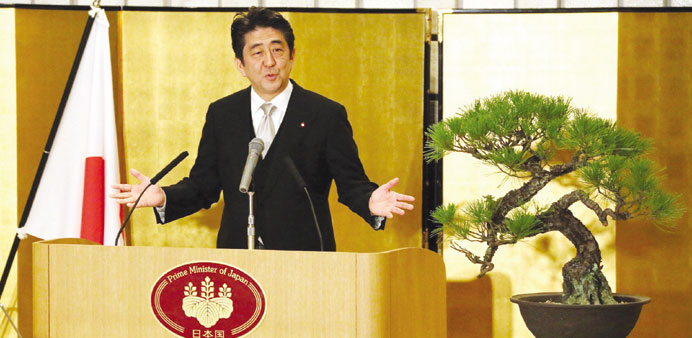
Abe speaks at a news conference yesterday in Ise, Mie prefecture, central Japan following his visit to the Ise shrine. Abe defended his visit to a controversial war shrine while admitting there was no immediate prospect of holding summits with his South Korean and Chinese counterparts.
Shinzo Abe has defended his visit to a controversial war shrine, but admitted there was no immediate prospect of summits with his South Korean and Chinese counterparts.
In the Japanese prime minister’s annual new year press conference, the conservative leader said that he wished to directly explain to China’s President Xi Jinping and South Korean President Park Geun-Hye why he visited Yasukuni Shrine, which honours Japanese war dead, including war criminals.
Late last month, Abe sparked harsh criticism from the neighbouring countries for his visit to the shrine, a place seen as a symbol of Japan’s war-time aggression in Asia, particularly by China and the two Koreas.
“I believe having dialogue with China and South Korea is extremely important for the peace and stability of the region,” Abe said. “There is no prospect for summit talks at this point. But because we have issues and problems, I believe it becomes more important that the leaders open our hearts and talk without preconditions.”
Abe came to power just over a year ago and has not held direct talks with either leader.
Japan has strained relations with both countries, largely because of persisting animosity over the violence perpetrated by its soldiers before and during World War II.
Abe’s visit to Yasukuni, a divisive move even in Japan, prompted concern from the United States, which said it was “disappointed” by a visit that “will exacerbate tensions with Japan’s neighbours”.
“Regarding my visit to Yasukuni, as I have outlined ... I would like to explain my true intention with sincerity and directly,” Abe said, repeating that his “door for dialogue” remained open.
In contrast to the absence of contact in Northeast Asia, Abe’s diplomatic schedule thus far has been heavy on the fast-growing countries of Southeast Asia.
In his speech, Abe also stressed his commitment to boost Japan’s once-floundering economy, including supporting much-needed wage-hikes that economists say are vital if his efforts to spark real inflation are to take root.
China and South Korea have been especially touchy about visits to the shrine by serving Japanese prime ministers and Abe is the first leader to pay homage at Yasukuni while in office since 2006.
Paying respects at Yasukuni is part of Abe’s conservative agenda to restore Japan’s pride in its past and recast its war-time history with a less apologetic tone.
He also wants to ease the restraints of Japan’s post-World War II pacifist constitution on the military, a move also likely to infuriate China and South Korea.
Abe said he hoped to deepen debate about constitutional reform within Japan and that he was confident he could make Beijing and Seoul understand.
“I am sure that I will be able to obtain the understanding of nearby nations about my administration’s pursuit of peace if I explain it thoroughly,” he said.
Chinese foreign ministry spokeswoman Hua Chunying expressed scepticism.
“Prime Minister Abe has paid lip service to the development of Sino-Japanese relations, but in reality, his statements are hypocritical,” Hua said. “It is he who has personally closed the door to dialogue with Chinese leaders.”
Both China and Korea suffered under Japanese rule, with parts of China occupied in the 1930s and Korea colonised from 1910 to 1945.
Business ties between China and Japan, the world’s second- and third-largest economies, have improved after a downturn sparked by a flare-up in 2012 in a row over tiny East China Sea islands controlled by Japan but also claimed by China.
But worries are growing that an unintended incident between Japanese and Chinese aircraft and ships playing cat-and-mouse near the disputed isles could escalate into a military clash.