


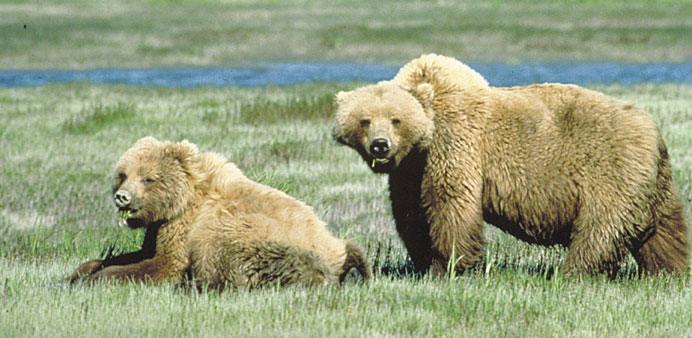
Grizzlies gorge themselves before hibernating each winter - yet they emerge healthy and slim.
Is Yogi Bear on the cutting edge of obesity research?
Dr Kevin Corbit, a scientist for the pharmaceutical giant Amgen, is convinced that by studying the behaviour of the brown bear - an animal that can weigh up to 500 kilos and consume up to 58,000 calories daily - we can understand a lot about our own eating habits and identify aspects of obesity that have yet to be fully explored.
“When I think of obesity, Yogi Bear comes to mind,” Corbit says, speaking in his Washington State University lab. More than a dozen beautiful grizzlies are being hosted here in Pullman, Washington, as rather large and cuddly stand-ins for mice and guinea pigs.
Bears are incredibly strong and sometimes fierce animals. They’re also the guardians of precious nutritional secrets that could be used to help solve the human obesity phenomenon.
In the weeks before their annual hibernation, they hoard honey, salmon and blackberries to gain about 100 kilos, which causes a surge of bad cholesterol and arterial pressure.
But unlike humans, their health is unaffected by this gorging period. Their arteries become unclogged when they lose the weight after hibernation, and they’re practically immune to diabetes. These researchers are trying to understand how their bodies work, performing biopsies on fat deposits and keeping close observation on their hearts.
The bears in this centre were born and rescued from Yellowstone National Park, where they had become dangerous to humans. The centre takes precautions to ensure the safety of its employees, including keeping the bears behind electric fences, and having them anaesthetised and placed in cages to allow physicians to examine them safely.
The scientists use honey in bottles to distract them when they’re undergoing certain tests — electrocardiograms (EKGs), for example — for which anaesthesia cannot be used. “It’s of course a long and complex study, but it’s definitely important for research,” says Alexander Kamb, co-ordinator of the Amgen research department that launched the programme two years ago.
The traditional approaches to studying obesity have yielded limited results, and drugs marketed to help people lose weight can only reduce a small percentage of fats from the human body.
Brown bears, on the other hand, are able to become obese in a healthy way every year, and still lose a large amount of weight without any adverse health effects, thanks to their faculty for controlling the hormone insulin.
The secret lies in the genome of these animals, which the researchers are trying to map, Kamb says. “Our goal is to be able to understand how the bears are able to perform such magic.”- Worldcrunch/La Stampa