


By Liu Tong/New York
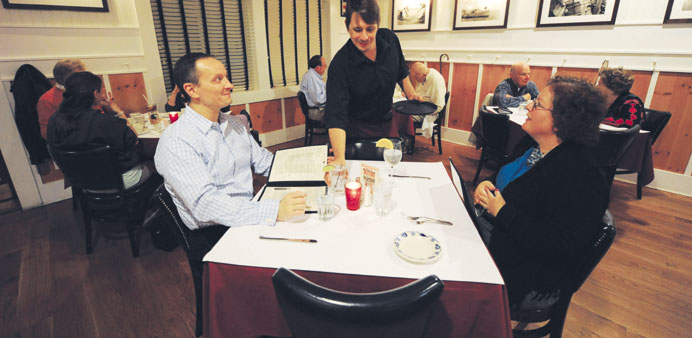
Because of several successive business trips plus my holiday in the United States, I have been living from one hotel to another for more than two weeks. Obviously I’m also obliged to dine out. What this means in terms of personal finances is that even before paying the hotel or restaurant bills, I must face a continued lineup of people expecting tips: waiters, room service, doormen — not to mention taxi drivers, unless of course you like to haul your heavy luggage out of the trunk yourself.
I have a colleague from Hong Kong, a place where tipping is also customary, though not as far-reaching or at such high percentages as it is in the United States. She, nonetheless, tried to pretend that she didn’t know how things work in the United States. The result: dirty towels left unchanged.
A friend who happens to be looking for an apartment tried hard to avoid renting anywhere with a concierge, because “If I carry something whenever I get home, the concierge will always come and open the door and expect to be tipped. But when do I come home without a bag or something in my hand? Imagine how much extra cost that is every month?”
Chinese people always talk about how expensive it is to live in America. And while I have studied all kinds of figures related to the fixed expenses of American households, none of them take tipping into account!
Indeed, bills in America often give people the wrong impression that it’s cheap, simply because the tax and the tips are rarely included. Sales tax rates can vary widely between different states, by as much as 10%. When I tried to pay a 10% tip on top of my bill in a Washington DC restaurant, I was immediately warned to add 15-20% by my friend “unless you want them to chase after you to recover it!”
I suppose I will learn how to live with all this tipping if I stay in the United States long enough. Still, on an economic level, I am convinced that the system is part of what makes hiring workers so costly.
Though it is a bit of a luxury to go and dine in a restaurant or take a taxi in America, the restaurateur or the cab company doesn’t seem to earn that much money. I once interviewed a top executive of a famous hotel chain who told me that he started off his career as a doorman, and that it was still some of the best money he’d ever earned.
The tipping custom exposes a particular feature: If one expects to get a better tip, one has to offer a better sales proposition. This includes the appearance and the figure, smartness or likability of the attendant - in other words it means individual employees making themselves marketable.
When I went to cover the Miami International Art Fair, on the way to the venue I had a taxi driver who spoke only Spanish, and made no effort to use even a single word of English with me. On the way back to the airport, instead, the cabbie was eager to tell me all the artists he likes and complimented me on how Asian women look younger than their age. Though I was obliged to tip them both, guess who I tipped more heartily?
Recently, more and more Americans have called for the end of the tipping system, saying waiters enjoy high wages and lower taxes — not to mention making customers feel obliged to pay additional rates for their meals. I am not optimistic. All I can hope for is the person serving me next time is smart and pleasant and can’t guess my age.- Worldcrunch/Economic Observer