


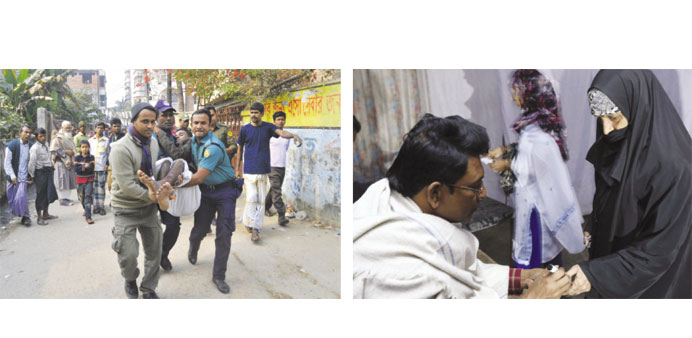
Police and volunteers carrying a voter injured by crude bomb thrown by opposition party supporters in Dhaka yesterday. Right: A polling official inking a female voter’s finger at a polling station during the 10th Bangladesh national elections in Dhaka yesterday.
Thousands of protesters firebombed polling stations and at least 18 people were killed as violence flared across Bangladesh yesterday during a walkover election boycotted by the opposition.
Police said they had opened fire at protesters as they torched more than 200 polling stations and stole and burnt ballot papers to try to sabotage the poll.
Two of those killed were beaten to death while guarding polling stations in northern districts but most of the victims were opposition supporters.
“We’ve seen thousands of protesters attack polling booths and our personnel at a number of locations with petrol bombs,” Syed Abu Sayem, police chief of the northern district of Bogra, said.
“The situation is extremely volatile,” he added after describing how thousands of ballot papers had been ceremoniously set on fire.
Most of the other victims were opposition activists shot by police, while a driver died of his injuries from a petrol bomb attack on his truck.
Police put the overall toll at 18 although the opposition said 22 of its supporters were killed.
“We were forced to open fire after thousands of them attacked us with guns and small bombs,” said Mokbul Hossain, police chief in the northern town of Parbatipur.
“It was a co-ordinated attack. They managed to seize some ballot papers and they tried to steal our weapons.”
In the capital Dhaka, whose streets were largely deserted apart from thousands of troops, police confirmed three petrol bombings of polling stations.
Tens of thousands of troops were deployed across the country after around 150 people had been killed in the build-up to the election.
The ruling Awami League has accused the main opposition Bangladesh Nationalist Party (BNP) of orchestrating the violence and has kept its leader under de facto house arrest.
The opposition had demanded that Prime Minister Sheikh Hasina make way for a neutral caretaker government before the election to ensure no ballot-rigging, a system in force in
the past.
It staged weeks of deadly protests, including transport blockades and calls for strikes, to press its demands.
A general strike called by the BNP, which began on Saturday, has now been extended until Wednesday morning as the party tries to ratchet up the pressure.
Although there was no immediate figure on turnout, officials acknowledged that it was poor.
“The turnout was low, partly due to the boycott by many parties,” said election commission chief Kazi Rakibuddin Ahmad.
Munira Khan, head of a Bangladeshi team of election monitors, said the vote had been characterised by “widespread apathy” and confusion about the choice on the ballot papers.
Eyewitnesses said there were no queues to vote, while local television reported that only a single person voted in the first three hours at one station.
Final results are expected in the early hours today.
But the outcome is not in doubt since voting took place in only 147 of the 300 parliamentary constituencies. Awami League candidates or allies had a clear run in the remaining 153.
Hasina’s government says it had to hold the vote after parliament’s five-year term expired.
“The turnout doesn’t matter, what is important is that the people defied violence and came out to vote,” Information Minister Hasanul Haq Inu told local television.
The BNP, whose leader Khaleda Zia has been confined to her home for a week, said the vote was a joke.
“The country has rejected these farcical elections which were meaningless, laughable and universally unacceptable,” said deputy leader Fakhrul Islam Alamgir.
Those who did vote showed little enthusiasm.
“I don’t really want to vote as I don’t think it’s a proper election with only the ruling party candidates participating,” Anwar Hossain said outside a polling station in Dhaka’s Azimpur
neighbourhood.
“But I am scared about what might happen if I don’t as the candidates might think I am
anti-Awami League.”
Analysts warn the election will likely stoke violence after the bloodiest year of unrest since Bangladesh broke free from Pakistan in 1971.
The former East Pakistan is the world’s eighth most populous nation but also one of the poorest in Asia, and more turmoil will undermine efforts to improve the lot of its population of 154mn—a third of whom live below the poverty line.
A local rights group says more than 500 people have been killed since January 2013, including victims of clashes that erupted after the conviction of Islamists for crimes dating back to the
1971 war.
The main Islamist party was banned by judges from taking part in the election, and its leaders are either in detention or in hiding.
Alarmed by the violence, the United States, European Union and Commonwealth all declined to send observers to yesterday’s election.
Bangladesh has been plagued by instability since independence, with nearly 20 coups
since 1975.
Opposition calls new strike after deadly vote
Bangladesh’s opposition called a new 48-hour general strike yesterday to protest at the killing of its supporters by police during a violence-plagued general election.
The Bangladesh Nationalist Party (BNP) said the shutdown would begin today morning, effectively extending a protest which was in place throughout the weekend as part of a campaign to wreck yesterday’s election.
“We’ve called the strike to demand that the government declares this farcical election null and void,” BNP spokesman Sayrul Kabir said.
“We are also protesting the deaths of 22 of our supporters in police firing during today’s vote,” Kabir added.
Police say at least 15 people were killed in violence during the voting, most of them opposition activists who were shot dead as they tried to disrupt the poll.
A polling officer and a security guard were also beaten to death by opposition protesters, according to the police.
The BNP and 20 other parties boycotted the election after Prime Minister Sheikh Hasina spurned their demands for the polls to be overseen by a neutral caretaker government.
Hasina’s Awami League is guaranteed victory as its members or allies faced a clear run in 153 of the 300 constituencies.