


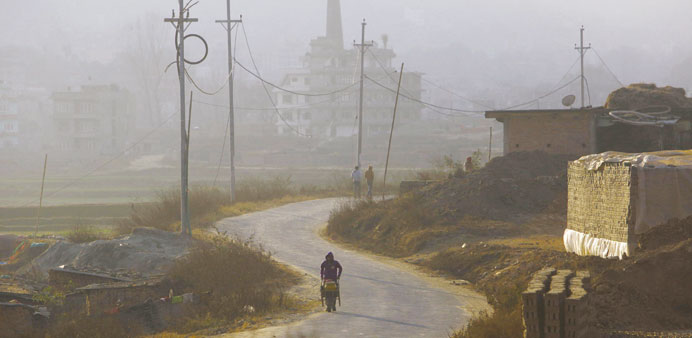
A man heading home with a cart filled with water as light fades before the sunset in Kathmandu yesterday. With 12-hour load-shedding in place, few areas in the capital have streetlights working.
The state power monopoly in Nepal has extended load-shedding hours from the earlier nine hours a day to 12 hours beginning yesterday.
The Nepal Electricity Authority (NEA), that had increased power cuts to nine hours a day in mid-December, announced last Friday further extension to 12 hours a day for domestic
consumers.
It is not an abnormal phenomenon for NEA to increase the hours of power cut following the onset of the dry season in Nepal, a country having one of the highest hydropower
potential in the world.
The drop-off in electricity generation owing to the decreasing water level in rivers has been blamed for the extended rolling blackout.
Load-shedding during winter last year had gone up to 16 hours a day.
With the new schedule becoming effective, Nepalis will have to cope with 84 hours a week in darkness.
“Increasing load-shedding is our compulsion,” Bhuwan Chettri, chief of NEA’s load dispatch centre, told Xinhua by phone.
“The power demand goes up to 100MW during the dry season as compared to the wet season and it is hard to balance the demand and supply chain.”
It has not even been a week since Nepal’s Energy Minister Umakant Jha promised to contain power cuts within 12 hours a day this winter that Nepalis have received the fresh load-shedding schedule equalling to the same period a day.
“This is just the beginning and the power crisis cannot be limited within only 12 hours a day in the near future,” Chettri said. “At present, there is a demand for 1,100MW a day while we have been able to supply only 575MW to 600MW.”
The NEA projected the demand for power to go up to 1,200MW a day during this year’s dry season.
Industrial consumers have been hit harder with the new schedule. NEA sources said load-shedding for industrial consumers have been extended to 14 hours a day.
“Sadly, the 14-hour-long power cut is arranged in a single shift. Factories that used to run three shifts of operation a day have been restricted to only one shift,” Nepali industrialist
Pashupati Murarka said.
Nepalese industries are forced to manage back-up power by installing diesel plants at their
factory premises.
“Almost 95% of the industries, hotels, hospitals and academic centres, among other business enterprises, have their own diesel plants,” said Murarka, who is also vice-president of Nepal’s apex business body, the Federation of Nepalese Chambers of Commerce and Industry.
“The cost of production goes up to around 35% higher, if the factories are run with diesel plants,” he added
Similarly, general consumers have also begun to install back-up electricity facilities in their residences to escape the dark hours. Nepal has already imported tens of millions of dollars worth of inverters and solar panels for household purposes.
Though the government had earlier announced import of 200MW hydropower from India to limit the deepening power crisis, the process has not begun so far.
More than 80% of Nepal’s hydro-power projects are run-of-the-river power stations and power generation from these projects goes down by as much as 60% during the dry season.
Several studies suggest that Nepal has commercially viable hydroelectricity potential of up to 45,000MW which remains largely untapped.