


|
Prime Minister Manmohan Singh yesterday launched three major projects in Kerala that are expected to provide a much-needed stimulus to the southern state’s economy. |
He inaugurated the prestigious Rs46bn liquified natural gas (LNG) regasification terminal of the Petronet LNG here which would fuel power projects with a total capacity of 1,000MW and help the state attain energy security.
Petronet, which imports LNG from Qatar’s RasGas, will also provide homes with cheap, clean and safe cooking gas through the City Gas project and make available compressed natural gas for vehicles.
The federal government has offered financial aid to convert state-run diesel buses to CNG.
“In the coming years, this terminal would bring enormous economic prosperity to Kerala, in fact to the entire south India,” the prime minister said. “Kochi has entered the world LNG map as an industry-oriented and investment-friendly destination.”
The terminal, which is currently running at 8% of its installed capacity, has already received two shipments from RasGas and started the supply to local consumers like the Fertilizers and Chemicals Travancore Limited (FACT) and Bharat Petroleum Corporation Limited (BPCL).
The first vessel from Qatar carrying 123,000 cu m of liquified gas arrived in August. The second vessel with 138,000 cu m of LNG arrived a month later.
“The cleaner and greener energy would protect Kerala’s natural beauty and it would meet the energy requirement of households and transport,” Singh said. “A new industrial corridor is also expected to come up along the route of the pipeline.”
The laying of the pipeline to carry the gas to Mangalore and Kovai-Bangalore is in progress despite stiff resistance at several places from misguided local community fearing possibility of a burst which the firm rules out as absurd.
The first phase of City Gas is expected to be ready by December. Nearly half a million residents of the port city and nearby areas will get uninterrupted cooking gas, considered to be the fuel of 21st century. Since it was lighter than air, even if there was leakage, it would get easily diluted.
Petroleum Minister Veerappa Moily urged the state to utilise the full potential of the project by making available the gas for households and vehicles in Thiruvananthapuram as well.
“We want to promote the use of LNG to meet 20% of India’s energy needs by next year. We would like to take the City Gas project to more homes and do it immediately,” he said offering financial support to the state to popularise the
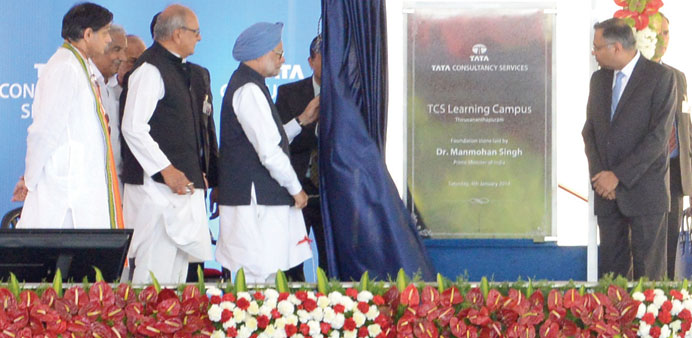
LNG for domestic and transport purposes. In Thiruvananthapuram, the prime minister laid the foundation stone for the world’s largest corporate learning centre of the Tata Consultancy Services (TCS) with a capacity to train 50,000 technology professionals every year, and a software development centre. The world-class learning facility will have a built-in space of 6mn sq ft.
“TCS is also setting up a software development Special Economic Zone (here). (It) will further enhance its presence in Kerala. I hope to see even more initiatives by TCS and other IT companies in Kerala especially in view of the high quality of human resource in the state,” the prime minister said.
The 15,000-seat Learning Campus with an outlay of Rs35bn will be located in 97 acres of the Technocity and the campus will feature residential accommodation for professionals and faculty.
“The TCS Learning Campus will be the new benchmark for corporate learning worldwide and this iconic facility will produce world class professionals to meet the future needs of the IT industry,” said N Chandrasekaran, chief executive officer and managing director of India’s largest software exporter.
The prime minister also launched an ambitious project of the state to make every resident in the state computer literate within 33 months, co-ordinating technology and ensuring that the benefits of information technology are accessible to even the lower strata of society.
“The Total E-literacy Campaign to be implemented using the tools of Information and Communications Technology (ICT) will help in reducing the digital divide. This will contribute to improvements in the living standards of the underprivileged population of the state,” Singh said.
Jointly launched by the federal and state governments in association with the departments of education, information technology and local self-governments, it is led by the P N Panicker Vigyan Vikas Kendra, promoted by the Department of General Education.
The first stage of the e-literacy project will be implemented in 100 villages spread over 14 districts. It aims at turning 1.5mn computer illiterates into e-literates.
“In fact we need such initiatives to be taken across the length and breadth of the country. This will help us in realising the full potential of ICT – in decentralised governance, in better delivery of services, particularly education, in financial inclusion and in e-commerce,” the prime minister said.