


Internews/Islamabad
Former Pakistani foreign minister and now a central leader of Imran Khan’s Pakistan Tehrik-e-Insaf Khurshid Kasuri has revealed that the leadership of Pakistan and India had worked out “about 80 to 90 details for resolution of Kashmir dispute” while the accord on Sir Creek dispute was ready for signatures and the two sides had developed understanding for the resolution of Siachen dispute in 2007.
“However, the judicial crisis in Pakistan [that eventually ousted former president Pervez Musharraf from power] stalled the Indian prime minister’s visit to Pakistan, who had to cover the leftover 10 to 15% details regarding the Kashmir dispute before announcement of its settlement,” Kasuri said in an interview published in The News daily yesterday.
He claimed that the armed forces and even the Inter-Services Intelligence (ISI) were fully on board in settlements of the disputes with India.
“It was a tactical move that the impression was subsequently given that the armed forces were not happy with the settlements of disputes with India since the move became necessary in the backdrop of developments in Afghanistan,” the former foreign minister added.
Offering his comments on the disclosure of Indian Prime Minister Dr Manmohan Singh on Friday that Pakistan and India had nearly reached the settlement of their disputes but that developments in Pakistan scuttled the historic way forward is vindication of his standpoint since long that he had been saying about it for quite sometimes.
“I will divulge all the details about the natty gritty of the relevant developments of the whole episode in my book, appearing soon,” he said.
Kasuri is known as an architect of new trends and liberalism in the foreign policy of Pakistan at least five to six people from the both countries have complete knowledge of the talks between the two countries while the record is also available in both the capitals about the progress and the same could be helpful for further engagement of the two countries.
He revealed that Pakistan and India’s high officials were engaged in quiet diplomacy for three years to reach consensus and they had meetings in 20 different world capitals in between, adding that Prime Minister Nawaz Sharif and former ruler retired General Pervez Musharraf are loggerheads with each other, and they have serious political differences but the both are having unanimity of views pertaining to negotiated and peaceful settlement of the disputes with India.
While referring to wikileaks, Kasuri reminded that former US ambassador in Pakistan Anne Patterson had meeting with him in 2010 in the presence of General Pervez Kayani, the then army chief, in Lahore and he (Kasuri) suggested that former Foreign Secretary Riaz Khan should be appointed Pakistan’s point-man on backchannel diplomacy since he was privy to the settlements of the disputes between two countries. General Kayani endorsed the proposal and subsequently Khan was accordingly appointed.
Giving a glimpse of Kashmir dispute resolution, he said that the leaders of Kashmir from the both sides had meetings in Islamabad, New Delhi and European capitals. Kashmir will be having special status as it was agreed between Sheikh Abdullah and Jawaharlal Nehru in their talks in early 1950s. The presence of Indian Army in the urban areas would be gradually thinned out. Also, a joint mechanism will be established across the Line of Control (LOC) dividing parts of Kashmir administered by both countries.
The understanding had some other features as well - that the agreement would be reviewed after every 10 to 15 years.
Kasuri is of the view that Pakistan and India have fought five wars on Kashmir, including three major and two limited wars, and that it has to come to an end as both the countries are nuclear. He said that it is not essential that 100% people of Pakistan, India and Kashmir would agree to such solution, but majority of the people of the region would endorse the settlement for the sake of peace and prosperity of the area.
Kasuri is hopeful that India will have a strong government in the wake of upcoming polls in that country, and Prime Minister Sharif, who has throughout been pleading for peaceful neighbourly ties with India, could take benefit from the work that has already been done for the peace between the two courtiers, and he could take initiative for the same purpose by carrying forward the process after Indian elections.
Kasuri is of the opinion that Pakistan and India cannot live in peace as long they don’t settle the dispute regarding Jammu and Kashmir. He said that peace and stability couldn’t endure in vacuum and for the reason Pakistan will have to make rapid development in economy and other sectors of the national life.
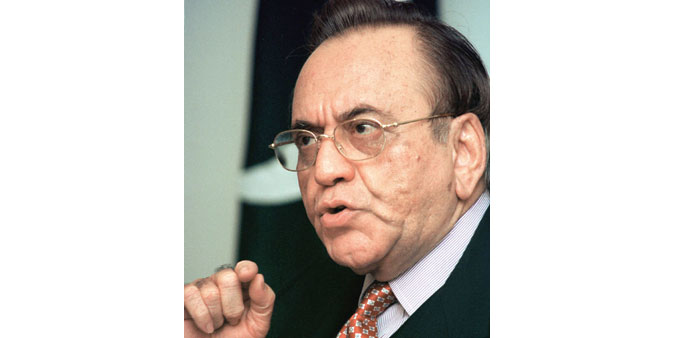
Khurshid Kasuri