


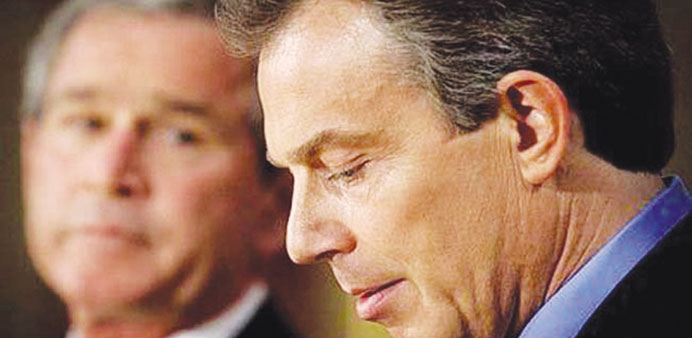
The commission inquiring into Britain’s involvement in the Iraq war and the country’s special relationship with America could publish its long-awaited conclusions in 2014.
By Patrick Wintour /London
It is not too far-fetched to say that 2014 will be the year the UK decides not its next government, but its political identity.
The vote in the European parliament elections in May, the likely verdict of the Chilcot inquiry into the Iraq war in the summer on the value of Britain’s special relationship with America, and the referendum on Scottish independence in September will be three indispensable waymarks that will help chart the shape of modern Britain.
It is possible that 2014 will be a year of convulsions. The UK Independence party (Ukip) coming first in the European elections, revealing an unstoppable tide of anger demanding an in-out referendum on Europe. The Chilcot inquiry and the British parliament concluding that the conduct of the Iraq war has revealed something rotten in the special relationship with America, and British foreign policy requires a re-evaluation to match that after Suez in 1956. Finally, the Scots defying the current polls and following the Scottish National party leader, Alex Salmond, towards separation, sending an electric shock through the English, London politics and business.
In such circumstances the 2015 general election will feel like an afterthought as numbed English politicians, stripped of authority, stumble to explain the revolution of 2014.
At present it looks more likely that Britain will muddle through 2014, even if it is the year of living dangerously. So Ukip fares well in the European elections, but does not improve on its second place in 2009. Chilcot admonishes Tony Blair personally for too much sofa government and too many easy assumptions, but does not find a conspiracy deliberately to mislead by the American and British political elites. And finally the Scots conclude the risk of breaking away outweighs the romance of independence. The solidity of British political institutions is once again confirmed.
Yet whatever the outcome, all the political parties face their own challenges in navigating these events, challenges that will reveal their readiness to govern. For the Conservatives the task will be not to panic if Ukip does very well in the European elections, driving the Tories into third place. The 2009 benchmark for Ukip is 16.5% of the vote and a total harvest of 2.49m votes. If Ukip does substantially better this time, the Tory right will demand a commitment to an EU in-out referendum in the 2015 manifesto, the use of the Parliament Act to force through James Wharton’s private member’s bill on a referendum and ever tougher policies on welfare and immigration.
European elections have a noble history of delivering such temporary bloody noses. In the 1989 elections, for instance, the Liberal Democrats came fourth behind the Greens, and it is not their only MP, Caroline Lucas, who is currently in coalition government, but the Lib Dems.
The wiser heads in Downing Street will call for calm, and tell Ukip voters that “you have had your fun, made your point and now it is time to return to the fold, and get on with the business of keeping the Europhile Labour party leader Ed Miliband from No10 Downing Street.” But polling conducted for Alan Bown, the Ukip donor, suggests Ukip voters are not just ex-Tories, and many of those who have defected from the Conservatives will never return. Still worse, they are not driven by Euroscepticism, but by an attitude to politics.
Ukip’s leader, Nigel Farage, will have to show after May that a Ukip vote in 2015 continues to be a serious vote. The aim is to show that in a small number of seats Ukip are the true challengers to Labour, the Liberal Democrats or even the Conservatives. It will use ammunition from the local elections and further polls in marginal seats to make that case.
For the Conservatives it will take the deftest of touches to lure back those Ukip voters, and yet not alienate the centre ground. The harder Cameron presses the immigration buttons, the easier it becomes for Labour to urge 2010 Liberal Democrats - the key to a Labour victory - to vote Miliband and throw out Cameron. Downing Street will require better management than shown so far to break out of this morass of anti-Tory tactical voting.
But Labour has it own internal management issues. Miliband will have to demonstrate by February that he is reducing the influence of the unions. Partial victory is within his grasp. He will also have to tread with caution through the Chilcot inquiry. His own hands are clean on Iraq as he was out of the country, but many big party figures - Tony Blair, Alastair Campbell and Jack Straw - will deeply resent it if he throws them to the wolves for electoral advantage. Some of Miliband’s advisers see Iraq as one of the best ways of breaking with the legacy of the previous Labour government.
But a vote for Scottish separation in September would lead to even greater turmoil in the Labour ranks. It would mean the Scottish working class had upped sticks and deserted Labour. With Scottish MPs excluded from the parliament in London, Labour would struggle to form a majority government again.
However, Miliband’s immediate task is to broaden the living standards agenda that he has brilliantly developed and turn it into a compelling argument about the future prosperity of the country. Labour strategists know the party will come under relentless attack about the return to growth, and the two different big judgments George Osborne and Ed Balls made in the wake of the 2010 election. If the election is as much about the best response to the crash of 2008 as the shape of Britain in 2020, Labour loses.
A lot of policy work will finally bear fruit - the Adonis commission on industrial growth, the Lyons review on house building and the IPPR thinktank’s report on the condition of Britain. Labour will use these cards to argue the Tories are creating a false recovery based on consumption and debt. On this economic issue, unlike the deficit, Labour can also create a vital wedge between the Tories (Conservatives) and Liberal Democrats as Vince Cable, the Liberal Democrat business secretary, has deep qualms about a recovery built on a house price bubble.
But Osborne will spend the autumn using every political device to try to pin Labour’s economics spokesman, Ed Balls, down on whether he will aim for a surplus by the end of the next parliament, and whether he will match coalition deficit cuts after 2015-16.
The Labour lead remains at around 6%, but polling on economic optimism, the wisdom of the Tory cuts and political leadership are all starting to point in the Conservative direction. Miliband has shown more courage and guile than many expected. He will need even more to stay ahead in the year to come. - Guardian News & Media