


|
Hungary should meet its 2013 budget deficit target of 2.7% of economic output in the “worst case” scenario and could actually beat it, the economy minister said yesterday. |
Counting on economic growth accelerating to 2% this year, double the rate expected in 2013, the government has pledged to keep the deficit below the European Union’s official limit of 3% in 2014 as well, when Prime Minister Viktor Orban’s ruling party faces re-election.
A series of deficit overshoots prior to 2010 had made Hungary Central Europe’s most indebted state and it still has debt of around 80% of economic output.
Orban’s government got the country out of the EU’s excessive deficit procedure after nine years largely with the help of hefty taxes on the finance, retail and energy sectors as well as a $14bn nationalisation of private pension fund savings.
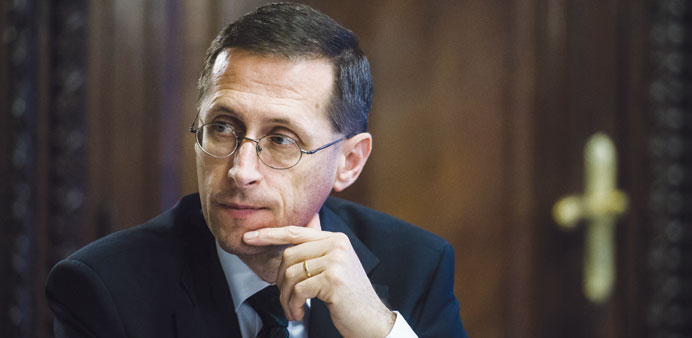
“We expect a 2.7% deficit, but this is the worst possible figure for 2013,” minister Mihaly Varga told a news conference, adding that the accounting treatment of local government finances and a capital injection into the savings banking sector could influence the final outcome.
He said these items were being discussed with the European Commission, which monitors the finances of EU member states.
“But this cannot be worse than 2.7%, if both items unfold as expected, then the deficit can even be 2.3% in 2013.”
Varga said a 93bn forint ($426.20mn) spending freeze in May and tax rises mid-year as part of efforts to keep the shortfall within the EU’s 3% limit helped keep the deficit under control.
Under cash-flow accounting and based on preliminary data, last year’s deficit was 929.2bn forints, below the original target, Varga said.
He added that inflation probably averaged around 1.8% in 2013, far below a 5.2% forecast in the original 2013 budget. As a result, revenue from major sources such as value-added (VAT) or excise tax fell short of expectations.
In VAT, the government collected 130-140bn forints - worth nearly half a% of gross domestic product - less than planned, Varga said. Higher tax revenues elsewhere helped mitigate that impact to some extent, he said.
David Nemeth, an analyst at the Hungarian arm of Belgian financial group KBC, said those risks would probably prevail into 2014 as inflation, projected at 2.4% in the approved budget, was likely to undershoot that level again this year. “Risks remain around the VAT revenues and others,” he said. “The excise tax is also a risk, the government expects the size of the grey economy to shrink and consumption to rise, which are relatively on the optimistic side of expectations.”
A recent sharp downward revision in the central bank’s inflation forecast, to 1.3% from 2.4%, highlighted a potential risk to revenues, he said.
Nemeth also said it was hard to see clearly on the spending side after many local government functions had been centralised, making comparisons with past years and identifying any slippages difficult.
There is also uncertainty about plans to tackle the problem of foreign currency loans taken out by many Hungarian households, who have since struggled to repay them, and whether the government will shoulder any of the cost.
“On the whole, a deficit of around 3% can be achieved (in 2014) unless there is a negative shock, which could necessitate an adjustment,” Nemeth said. “If we were to see a jump in spending in the first three months, that would also have to be offset somehow, but we do not see that for now.”