


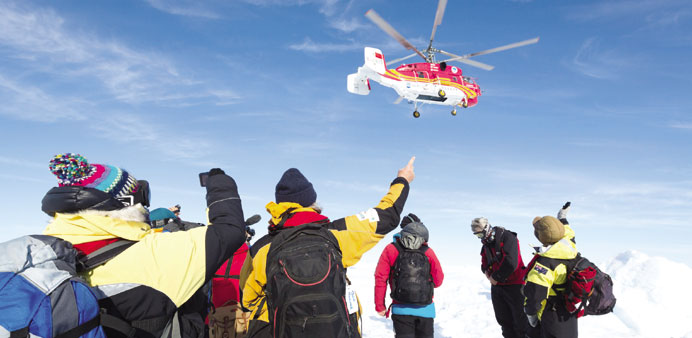
This image taken by expedition doctor Andrew Peacock of www.footloosefotography.com shows a helicopter from the nearby Chinese icebreaker Xue Long above passengers from the stranded MV Akademik Shokalskiy.
A rescue effort to remove 52 passengers on board a research ship that had been trapped in Antarctica ice was successful, and they were evacuated safely by helicopter, the expedition leader said yesterday.
A helicopter from the Chinese icebreaker Xue Long (Snow Dragon) ferried passengers in small groups several times from the ice-bound ship, the Akademik Shokalskiy, and transferred them to an Australian Antarctic supply ship, the Aurora Australis.
Chris Turney, who led the private expedition, said that conditions at sea had improved enough to mount the rescue, following days of blizzards, fog and shifting sea ice.
“We’ve made it to the Aurora Australis safe & sound,” Turney said on Twitter.
Turney documented the rescue mission from the stranded ship with regular posts depicting videos and photographs.
The ship’s 22 Russian crewmembers planned to stay with the well-stocked vessel until it was freed from the ice, the New York Times reported, thanks to a change in wind direction allowing it to get back under way under its own steam.
Failing that, a larger icebreaker could be brought in to free it.
Television pictures showed the helicopter checking out a makeshift landing zone near the marooned ship, before picking up the first group of 12 passengers.
Turney posted a short video clip of a second helicopter taking off. His seven photographs showed passengers bundled in heavy parka jackets, snow goggles and hats, boarding a helicopter amid a backdrop of snowdrifts and clear blue skies.
The Russian-owned research ship left New Zealand on November 28 to commemorate the 100th anniversary of an Antarctic journey led by famed Australian explorer Douglas Mawson.
Of the 52 passengers, 26 were tourists paying for a place on the expedition.
It became trapped on December 24, 100 nautical miles east of French Antarctic station Dumont D’Urville and about 1,500 nautical miles south of Australia’s island state of Tasmania.
Everyone on board was believed to be in good condition and weren’t in any immediate danger on the ship.
A helicopter rescue was the last option left for the passengers after French, Chinese and then Australian icebreakers failed to smash through more than 20km of pack ice to free the Shokalskiy.
The Chinese ship got within sight of the Shokalskiy on Saturday, but turned back after failing to break through the ice, which was more than 3m thick.
Two other vessels, Australia’s Aurora Australis and a French flagged ship, also tried to help but failed to reach the ship because of strong wind and heavy snow.
The Sydney Morning Herald, which has a reporter aboard the Aurora Australis, said many of those brought off the Russian ship were relieved, with one woman crying tears of joy.
“It really has been an emotional rollercoaster,” Joanne Sim told the newspaper.
Though they are free from the ice, the group is not expected to reach dry land for several weeks yet, with the Australis having to travel back to the southern city of Hobart via Australia’s Casey Antarctic base to refuel.
Passengers on the stranded ship – an eclectic mix of scientists, tourists and journalists – had been following in the footsteps of Mawson and his 1911-1914 expedition, carrying out the same scientific experiments that Mawson’s group conducted during their expedition, partly in an attempt to discover how quickly the Antarctic’s sea ice is disappearing.
Board games, first-aid and other skills courses, movie marathons in the ship’s auditorium and walks on the ice have helped to pass the time. They even penned a theme song about their adventure and filmed themselves singing it on the top deck.
Though they are in remote Antarctica the group dropped in on one of the world’s biggest New Year’s parties, broadcasting live to celebrations in New York’s Times Square from their marooned vessel.