


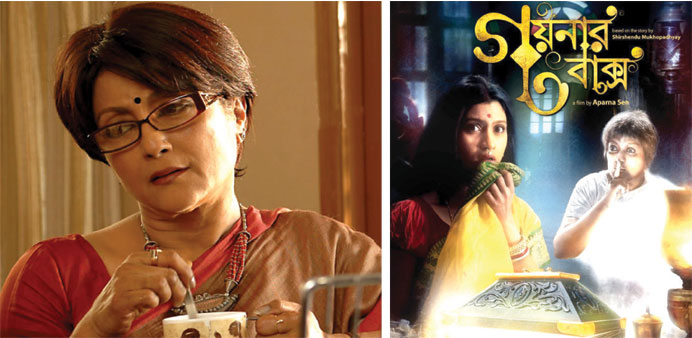
VETERAN: Aparna Sen’s work has spanned decades of brilliant cinema, including the latest offering Goynar Baksho, right.
By Gautaman Bhaskaran
When one grows up in Kolkata, as I did, one cannot miss some things about the city that grew out of an unhealthy stretch of marshy land which Englishman Job Charnock discovered on a mid-day halt he made one humid August day in the late 1600s.
The city’s delicious sweetmeat, football craze, Rabindra Sangeet and, finally, cinema, enriched by celebrated directors like Satyajit Ray, Mrinal Sen, Ritwick Ghatak, Buddhadeb Dasgupta, Rituparno Ghosh and, of course, Aparna Sen.
Sen was barely 16 when she stepped under Ray’s arc lights in Teen Kanya (Three Daughters), and yes the helmer was known to her parents (her father was the celebrated film critic, Chidananda Dasgupta).
Otherwise, I wonder whether Aparna would have been allowed to act then. She did several movies later, some by Ray himself — like Aranyer Din Ratri (Days and Nights in the Forest) and Jana Aaranya (The Middleman).
As much as Sen was a fine actress, her crowning glory was the cinema she created, and her very first work in 1981, 36 Chowringhee Lane, still remains my favourite in her oeuvre.
Call it nostalgia, call it unmistakable association with the metropolis, the film haunts me even today. Now, Chowringhee Lane actually exists in Kolkata, and is located just at nodding distance from the famed New Market — perhaps, the country’s first shopping mall that used to throb with life during Christmas and New Year.
I remember walking along the narrow Chowringhee Lane for many, many years, and when I saw on screen Violet Stoneham (played with remarkable grace by the late Shakespearean actress, Jennifer Kendal, also Shashi Kapoor’s wife), the aging Anglo-Indian teacher riding a hand-drawn rickshaw (which still exists in the city) to and from her flat on that street, a kind of magical realism engulfed me.
About loneliness — hauntingly brought out in the movie — with the Christmas Carol, Silent Night, Holy Night, heightening Stoneham’s sorrow even as her two young friends party the night away, 36 Chowringhee Lane was mesmeric.
The friends, played by Dhritiman Chatterjee (who has since then made Chennai his home) and Debashree Roy (my school mate, and another point of reminiscence), use Stoneham’s flat to make love, having wormed their way into the teacher’s heart on the pretext of wanting a place for him to write his book in peace.
Yes, Aparna (or Rinadi as she is affectionately and reverentially addressed) went on to make more movies — some as scintillating as Paroma, The Japanese Wife and Mr & Mrs Iyer — but somehow, 36 Chowringhee Lane refuses to stop tugging at my heart.
When I recently met her at the Abu Dhabi Film Festival, where she screened her latest work, Goynar Baksho (The Jewellery Box), it was with Chowringhee… that I began my conversation. She found it amusing that I was still thinking of a movie she made decades ago.
Admittedly, I loved Goynar Baksho. It is pure wit, marvellously directed and brilliantly performed by two women, Moushumi Chatterjee as Rashmoni and Konkana Sen Sharma as Somlata. Adapted from Shirshendu Mukhopadhyay’s novel, Goynar Baksho is funny, yet a scathing study of the degenerate Bengal zamindari.
The core of the story, which begins just after India’s independence and stretches till the birth of Bangladesh tracing the lives of three women in a family of lazy men, is a jewellery box — which Rashmoni guards even after she is dead!
Married at 11 and widowed at 12, she might have sacrificed colours and life’s other charms, but not the box of precious of gold and stones which came to her as part of her dowry. Much later in life, she befriends her younger brother’s wife (Somlata), and returns ever so often to the house as a ghost, instructing the young woman how to keep the box safe.
Ultimately, when Somlata’s daughter (Chaitali, essayed by Srabanti Biswas) grows up, Rashmoni asks her to give the jewels away for the Bangladesh war.
The film has hilarious moments — with Rashmoni the ghost even sharing a cigarette with Chaitali or riding the pillion of her scooter. The third segment is rather weak, though the movie is nearly always cheerful and uplifting — with the men shown as bumbling idiots.
There is one scene where Somlata’s husband, depressed over the family’s dwindling fortunes, tries to hang himself from the roof. But ends up making a mess of even that, and when his wife asks him whether he believes in ghosts, he jumps into her arms! Even Rashmoni’s acidic rants are laced with laughter, and couched in all this is her smartness in an essentially man’s world.
As Aparna admits in the course of a conversation with me, this is what women in those times did. Somlata is as clever as Rashmoni, “negotiating a space for herself in the male dominated household and society. Timid outwardly with a stutter (I really wanted to introduce this human element in her character), Somlata turns out to be the force behind the family, gradually pulling it out of the ruin that the men pushed it into, with their debauchery that extends to heaping riches on their mistresses”.
Sen tells me that when she read Mukhopadhyay’s novel (strictly speaking a novella) in one of the Durga Puja issues of a popular magazine, “I was frankly quite taken in by the plot’s magic realism and ghostliness, and its Latin American feel.”
In fact, Sen wanted to make Goynar Baksho even before she made Mr & Mrs Iyer in 2002. “But it fell through, because the producer backed out”. So she began shooting Iyer at the end of 2001, and quite eerily, canned her last shot on the day the Godhra massacre happened in February 2002.
Mr & Mrs Iyer narrates the horrific experience of a man and a woman, total strangers, travelling in a bus that is stopped by an angry mob out to butcher Muslims.
(Sen plans to make a sequel to Mr & Mrs Iyer, and tell us what happened after the two parted in a Kolkata railway station.)
Sen had to wait to complete three more films — 15 Park Avenue, The Japanese Wife and Iti Mrinalini – before the reluctant producer smiled and opened his money box to let Rinadi shoot the story of that merry ghost and her naughty adventures. Which included causing an earthquake in Somlata’s kitchen, whispering the names of mistresses in the ears of the men as they assembled to chastise Somlata, and egging the young bride to have an extra-marital fling with a stalker.
“You have only one life. So make the best use of it”, Rashmoni tells Somlata. Goynar Baksho is full of such amusing lines.
*l Gautaman Bhaskaran has watched just about every film of Aparna Sen, and may be e-mailed at [email protected]