


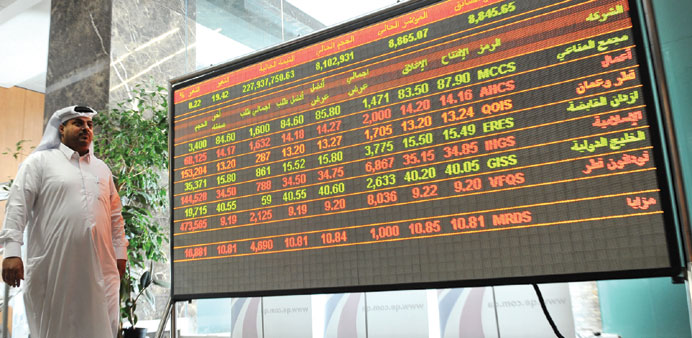
The Qatar Exchange with an ambitious international intention might not have produced generous returns compared to the year-to-date gains of some of its Gulf neighbours. But 2013 was an eventful year as the bourse fought its way into global index compiler MSCI’s and S&P Dow Jones’ ‘emerging market’ index from the ‘frontier’ status, which should boost further capital flows into the QE.
By Santhosh V Perumal
Looking back, the Qatar Exchange can certainly be proud of the 2013 performance partly on its own achievements and partly, but pertinently, due to the supporting environment created by the country in inculcating an investment culture, notably in inviting foreign capital.
Year 2013 also saw the end of a three-year initial public offering (IPO) drought with a sizeable QR3.23bn maiden offer from none other than Qatar Petroleum (QP) for its wholly-owned subsidiary Mesaieed Petrochemicals Holding Company (MPHC) as part of decade-long series of IPOs to encourage long-term savings by Qatari citizens.
The local bourse with an ambitious international intention might not have produced generous returns compared to the year-to-date (YTD) gains of some of its Gulf neighbours. But 2013 was an eventful year as the bourse fought its way into global index compiler MSCI’s and S&P Dow Jones’ ‘emerging market’ index from the ‘frontier’ status, a process that ought to see further capital inflows into QE.
Nicholas Wilson, chairman of Qatar Investment Fund (QIF) - an Isle of Mann-registered entity - said the QE has witnessed more than 22% growth in its key index ever since MSCI’s decision to upgrade Qatar to ‘emerging’ market from ‘frontier’, effective July next year.
Asserting that the MSCI upgrade can make the QE “a jewel in the emerging market”; he expects $400mn funds inflow into the local bourse, which was mainly supported by non-Qatari institutional investors in 2013.
“We believe this is a key catalyst for the market, not only for improving volumes on increased foreign fund flows, but also by balancing out the denomination of Qatari/retail versus foreign/institutional investments into the market. This will be further reinforced if limits on foreign ownership are eased to internationally compatible levels,” Beltone Financial said.
The QE’s upgrade had been discussed by MSCI for a long time but because of the foreign ownership limits (FOL), it missed the bus many a time. However, QE chief executive Rashid Ali al-Mansoori said FOL can reach up to 25% in the listed companies, while some companies allow higher limits.
The bourse, whose YTD gains now stands at 24%, amid concerns on easing of monetary stimulus measures in the US swaying the markets across the globe.
Although the QE had had a knee-jerk panic reaction, it regained its resiliency as investors were cognisant of strong macro framework of Qatar, which is poised for a slowdown, but to remain the fastest growing economy in the world.
Small and mid cap equities gave the bullish impetus to the market where transport, telecom, industrials, consumer goods and banks and financial services sectors were seen to outperform the main index.
Their performance indicates the bullish outlook in an otherwise hydrocarbons-dominated economy.
The QE-listed companies also bettered their net profitability in the first nine months, reporting a 6.67% growth in net profits against 1.88% in the year-ago period, indicating renewed confidence in the private sector.
The net profitability gain was mainly aided by the insurance, consumer goods, real estate and transport sectors. Their contribution to the overall net profits also improved.
In recognition of its achievements and reflective of the global attention, the QE, which has a capitalisation in excess of $152bn (QR555bn), is now a full member of the World Federation of Exchanges.
Foreign partner NYSE Euronext was only happy that the local bourse’s strategic objectives have been achieved, which led to its exit, four years after it entered the fray with a $200mn investment by picking up a 20% stake.
The bourse also launched a new Al Rayan Islamic index as part of broadening its indices. This new index is apart from the Qatar Index and the All Share Index.
The QE also undertook a semi-annual revision by including Al Meera Consumer Goods and Qatar Insurance to replace al khaliji and Mazaya Real Estate in its 20-stock Qatar Index with the maximum weight a single stock can hold within the QE index capped at 15%.
The first salvo in 2013 came with a decree in January when Qatar exempted non-Qatari investors from paying taxes on their share of profits in the joint stock companies listed on the QE; a move that is ought to augur well not only for those overseas investors but also for the domestic entities.
Another Emiri decree helped the Qatar Financial Market Authority (QFMA) set up a grievance committee with an aim to protecting the rights of investors, including minority shareholders.
Qatar, which is keen to attract more foreign capital into the market, also extended the tax exemption benefits enjoyed by stocks to other investment instruments as the year saw also sovereign bonds being traded in the secondary market.
It launched liquidity providers (LP) scheme, in what could pave way for enhanced liquidity and greater price stability of admitted stocks.
However, Wilson of QIF was of the view that there was “a need to tackle the liquidity problems so that foreign institutional investors can get a reasonable toehold.”
Besides, the bourse also launched securities and lending borrowing (SLB) scheme, enabling settlement of securities sold short, as well as “sponsored access”, allowing sponsoring members to provide eligible customers (sponsored participants) direct access to the trading system of the bourse.
The QE enhanced its delivery-versus-payment mechanism to support SLB, as part of efforts to woo foreign investors. It also enhanced its online data services by incorporating real-time updates to the order book of each listed stock as part of measures to provide additional security and robustness to market data.
The QE, which aims to be the preferred investment destination, got a shot in the arm with many UK and global companies evincing interests in cross-listing their equities on local bourses in the Gulf region, Richard Webster-Smith, manager, primary markets (Middle East and Africa), the London Stock Exchange, had told Gulf Times in an exclusive interview.
Although there weren’t any new listings, the bourse’s top official Hussain Ali al-Abdulla had hinted early this year at the listing of four QP companies. Later in the year, Supreme Council for Economic Affairs, chaired by HH the Emir Sheikh Tamim bin Hamad al-Thani, was given a presentation relating to the listing of four QP subsidiaries over a period of 10 years.
HE the Finance Minister Ali Sherif al-Emadi said the first phase of the listing would begin by offering shares of MPHC, a firm that comprises three major industrial entities Q-Chem I, Q-Chem 2 and Qatar Vinyl Company.
MPHC - whose interests in the three companies generated QR4.3bn revenues and QR1.6bn net profit in 2012, is tapping the market to by offering 323.19mn shares at QR10.2 a piece.
“It will be a unique opportunity for all participating Qatari nationals to benefit directly from the development of the economy and the prosperity of petrochemicals sector in Qatar,” HE the Energy and Industry Minister Dr Mohamed bin Saleh al-Sada said, adding the MPHC IPO is an important step towards realising the Qatar National Vision 2030.
Doha Global Investment, which was supposed to have come out with a maiden offer during April this year, had postponed the issue to later date. Qatar Airways also toed a similar line citing market conditions.
Expecting the QE to be among the most active Gulf bourse over the next 12 months as more listings could be expected, a Deloitte survey said respondents were “cautiously optimistic” about the prospects for IPO volumes and trading to increase, with a pipeline of offers looking to target the liquidity in the market.
The QE had held its second IPO advisory group meeting as part of its broader effort to strengthen its engagement with the financial community, aimed at seeking inputs from the various market participants on its new initiatives and comes in the wake of many listings that are on the pipeline.
QE chief executive al-Mansoori had urged family-owned companies to “think seriously about transforming into public shareholding companies because through listing they can not only reap advantages but also value-add to the domestic economy.
“Distributing the shares as a public company will offer liquidity and a valuation because public offering monetises the value of the company at a market-driven price,” he said.
According to QE director of listing Abdul Aziz al-Emadi, private and family-owned companies constitute 90% of the total registered companies in the Gulf region.
“The listing process may not be the perfect solution for everyone, but it should be a strategic choice,” he said, adding the over-reliance on bank loans may leave companies vulnerable to liquidity risks.
QIF had said the near term catalysts for the Qatari market include the upcoming earnings season, the recent upgrade to the MSCI ‘emerging’ market index and a pipeline of IPOs against a background of attractive valuations.
Amwal Investment also held that valuations seem to be a compelling factor for investors to look at the QE because Qatari stocks are relatively cheap compared to the rest of the world.
“Valuations are still at a discount compared to the rest of the world, and also importantly, expected returns for other investment alternatives are low,” Sami al-Khairi, vice president (business development), Amwal Investment, said.
By end-November 2013, total market capitalisation of the QE Index stood at QR555bn, equivalent to 76.3% of Qatar’s gross domestic product (GDP) compared to 62.9% in Saudi Arabia, 59.3% in Kuwait and 46.4% in the UAE.
During the fag-end of 2013, the Qatar Central Bank announced that it, along with the QE, established the Qatar Central Securities Depository, a private shareholding company that replaces the central registration department.
The new year is certainly going to be a busy one for Qatar’s capital market not only because of the listing of MPHC, but the bourse also could see the advent of other investment avenues such as exchange-traded funds.
Qatar shares edge higher ahead of QP unit IPO
The Qatar Exchange yesterday drove back in positive trajectory, albeit at lower levels, as local investors will today start subscribing to the QR3.23bn initial public offer of a Qatar Petroleum unit. Buying interests were seen mainly at the industrials and the low-volume insurance counters as the 20-stock Qatar Index rose by a marginal 0.08% to 10,368.2 points.
Small and mid cap equities came under buying pressure in the bourse, whose key index has been remaining above the 10,000 mark for the 34th consecutive day.
Mesaieed Petrochemical Holding Company, a holding entity of Q-Chem I, Q-Chem II and Qatar Vinyl Company is offering 323.19mn shares, primarily to local investors, at QR10.2 per share through its maiden offer.
Local retail investors turned marginally bullish and both foreign individual and institutional investors continued to be bullish, but with lesser intensity in the market, which is up 24.04% year-to-date.
Amid an overall bullish run, the index that tracks Shariah-principled stocks was rather unchanged.
The 20-stock Total Return Index was up 0.08% to 14,813.77 points and the All Share Index (with wider constituents) by 0.05% to 2,585.88; whereas the Al Rayan Islamic Index was unchanged at 3,037.59.
All the three indices factored in dividend income as well.
Insurance stocks rose 0.78%, followed by industrials (0.41%), real estate (0.12%) and telecom (0.1%), while transport fell 0.21%, banks and financial services 0.19% and consumer goods lost 0.17%.
Influential gainers included Barwa, Doha Bank, Qatar Islamic Bank, Qatari Investors Group and Gulf International Services.
However, Industries Qatar, QNB, Commercial Bank, Mazaya Qatar, Vodafone Qatar and Nakilat bucked the trend.
Market capitalisation was down 0.12%, or QR67mn, to QR554.55bn. Micro and large cap stocks fell 0.49% and 0.29%, whereas small and mid caps rose 0.93% and 0.44% respectively.
Qatari individual investors turned net buyers to the tune of QR2.52mn against net sellers of QR10.39mn the previous day.
Non-Qatari institutions’ net buying was QR3.67mn compared to QR8.65mn on Sunday.
Foreign institutions’ net buying stood at QR4.98mn against QR30.8mn the previous day.
Domestic institutions’ net selling amounted to QR11.19mn compared to QR29.03mn on Sunday.
Total trading volume was down 2% to 7.68mn stocks, value by 11% to QR256.7mn and transactions by 27% to 3,684.
The transport sector’s trading volume plummeted 51% to 0.33mn shares, while value rose 2% to QR17.97mn but deals fell 31% to 177.
The consumer goods sector witnessed 48% plunge in trading volume to 0.54mn equities, 38% in value to QR12.64mn and 53% in transactions to 249.
There was 41% shrinkage in industrials sector’s trading volume to 0.92mn stocks, 32% in value to QR65.32mn and 32% in deals to 1,119.
The real estate sector’s trading volume declined 32% to 0.82mn shares, value by 34% to QR19.31mn and transactions by 17% to 396.
However, the telecom sector’s trading volume more than tripled to 2.16mn equities, value surged 77% to QR24.99mn and deals by 39% to 367.
The insurance sector saw its trading volume gain 20% to 0.06mn stocks, whereas value shrank 5% to QR2.31mn and transactions by 21% to 37.
The banks and financial services sector reported 6% rise in trading volume to 2.86mn shares and 4% in value to QR114.13mn but on a 27% fall in deals to 1,339.
In the debt market, there was no trading of treasury bills and government bonds.
In a communiqué, the QE spokesman said the Qatar Financial Market Authority has declared tomorrow as an official holiday for the bourse.