


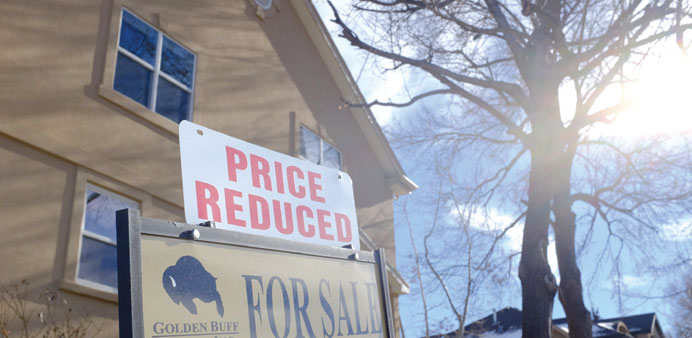
A “Price Reduced” sign stands in the yard of a single family home for sale in Denver, Colorado. Contracts to purchase previously owned US homes rose less than forecast in November, indicating higher borrowing costs are holding back the recovery in residential real estate.
Bloomberg
Washington
Contracts to purchase previously owned US homes rose less than forecast in November, indicating higher borrowing costs are holding back the recovery in residential real estate.
A gauge of pending home sales increased 0.2%, the first gain in six months, after a 1.2% drop in October that was larger than initially reported, the National Association of Realtors said yesterday in Washington. The median projection in a Bloomberg survey of economists called for a 1% advance.
Higher mortgage rates, tight lending standards and price increases driven by a limited supply of homes for sale are discouraging some prospective buyers. Further gains in hiring, household wealth and consumer confidence would help boost the housing recovery and give greater momentum to the economy.
“Next year we think housing is going to continue to grow at a fairly solid pace,” said Daniel Silver, an economist at JPMorgan Chase & Co in New York. “You have a story of things getting better in the economy, better job growth, driving the numbers.”
Estimates in the Bloomberg survey of 30 economists ranged from a decline of 1% to an advance of 5%.
Stocks were little changed as the Standard & Poor’s 500 Index headed towards its biggest annual gain since 1997. The S&P 500 fell less than 0.1% to 1,840.69 at 11:13 am in New York.
Purchases dropped 4% from the year prior on an unadjusted basis after a 2.7% decrease in the 12 months ended in October, the NAR reported.
The pending sales index was 101.7 on a seasonally-adjusted basis. A reading of 100 corresponds to the average level of contract activity in 2001, or “historically healthy” home- buying traffic, according to the Realtors group.
Two of four regions showed a decrease from October, with pending home sales in the Northeast dropping 2.7% and the Midwest falling 3.1%. Pending sales rose 2.3% in the South and 1.8% in the West.
Economists consider pending home sales a leading indicator because they track contract signings. Existing-home sales are tabulated when a contract closes, usually a month or two later.
Purchases of previously owned homes dropped 4.3% to a 4.9mn annual rate in November, the lowest level of the year, the National Association of Realtors reported earlier this month. Nonetheless, the NAR projects 2013 will be the best year for the industry since 2006, with an estimated 5.1mn transactions.
“We may have reached a cyclical low because the positive fundamentals of job creation and household formation are likely to foster a fairly stable level of contract activity in 2014,” NAR chief economist Lawrence Yun said in a statement.
New-home sales were close to a five-year high in November as builders responded to pent-up demand unleashed by employment gains and record stock prices.
The S&P/Case-Shiller national home-price gauge rose 11.2% in the third quarter from the same period in 2012, the biggest year-over-year advance since the first three months of 2006. Its index of property prices in 20 US cities, set for release tomorrow, probably increased 13.5% in October from a year earlier, according to a Bloomberg survey.
Higher mortgage rates are also reducing affordability. The average rate for a 30-year, fixed mortgage was 4.48% in the week ended December 26, up from 3.35% a year earlier. In August, the rate reached a two-year high of 4.58%. After two years of rapid-fire growth, the housing market shows signs of returning to normal, said Budge Huskey, president and chief executive officer of Coldwell Banker, a real estate services firm in Madison, New Jersey.
“We’ve been picking up slack, that’s why the pace has been so torrid,” Huskey said in an interview. “Going forward, when we start to take a look at year-over-year gains and activity, it’s going to appear far more boring, which is not a bad thing.”
Investors and speculators who contributed to the run-up in property values in recent years are becoming a less-important factor in the market, Huskey said.
“We’re getting on the right track,” he said. “We’re now getting to a real estate environment that’s more about the fundamentals and less about these external factors that are artificially shaping the recovery.”