


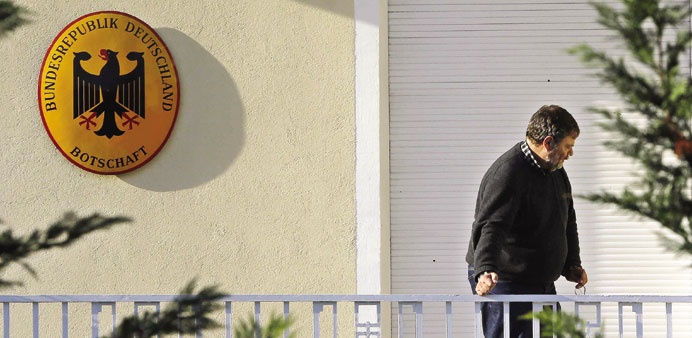
Bullet holes from the attack are seen above and behind Dold as he stands at his residence’s balcony.
Unidentified assailants opened fire on the German ambassador’s residence in Athens with a Kalashnikov assault rifle yesterday in an attack seen as an attempt to sour relations between Greece and its biggest creditor nation.
Police said about 60 shots were fired at the high-security residence on a busy street of a northern suburb.
At least four bullets were lodged in the walls of the house and four hit the metal gate of its perimeter. No one was hurt.
Anti-German sentiment has grown during Greece’s prolonged economic crisis and many of those struggling with record unemployment and falling living standards blame Germany’s insistence on fiscal rigour for their economic woes.
Germany is the biggest contributing nation to Greece’s 240bn-euro bailouts which have kept the country afloat since 2010.
Germany has at least 15bn euros ($20.67bn) of bilateral loans extended to Greece as part of the bailout.
No one has claimed responsibility for the 3.40am (0140 GMT) attack which police believe was carried out by members of leftist guerrilla groups. A police official, who spoke on condition of anonymity, said at least two assailants on foot were involved.
“Whoever is responsible for this act: You will not succeed in disrupting the close and friendly relations of our two countries,” said Ambassador Wolfgang Dold, who was at home at the time of the incident.
The residence was the target of an attack in 1999 when members of the now dismantled extremist group November 17 fired a rocket-propelled grenade that hit its roof.
Pictures lampooning German Chancellor Angel Merkel are commonplace in Athens while groups opposing Greece’s bailout frequently protest outside the German embassy.
Public sector workers pelted a German diplomat with water bottles and coffee in a protest over austerity measures last year.
Yesterday’s attack drew condemnation from across the political spectrum, with the anti-bailout opposition Syriza party saying it undermined Greece’s struggle against austerity.
“Who benefits from the attack?” asked Syriza lawmaker Manolis Glezos, a hero of Greek resistance to the Nazi occupation of World War II. “Certainly not the Greek people.”