


Oil and gas industry is the “foundation and primary pillar” of Qatar’s economic and social development, said HE the Minister of Energy and Industry, Dr Mohamed bin Saleh al-Sada.
“Day by day, Qatari manpower and human resources are reinforcing their position as the driving force behind this development,” al-Sada said in an interview with ExxonMobil Qatar’s Sila magazine.
“Pioneering gas development and infrastructure projects like the North Field Alpha project and Ras Laffan Industrial City, which were built and managed directly by Qatar Petroleum, set the foundation for the next generation of projects,” the minister explains.
“Qatar, with abundant North Field gas reserves, is distant from consuming markets of the east and west. The markets of the west were already satisfied with gas from the North Sea, Russia and Algeria. The only way to get our gas to the consuming markets of the east was through the LNG route. Starting with the Qatargas joint venture securing a long-term supply contract to Japan, followed by the RasGas joint venture securing contracts to South Korea and India, the solid foundation for the LNG industry was set,” al-Sada said in the Sila Winter 2013 issue.
As such, an ambitious expansion of the LNG industry in Qatar saw novel and innovative technology that has culminated with the world’s top LNG export capacity of 77mn tonnes per year, with Qatar’s LNG fleet reaching any destination around the globe.
Partnerships are vital, and none has meant more to the region than the partnership between Qatar Petroleum and ExxonMobil.
“I recall it started with Mobil entering the Qatargas 1 joint venture in the early 1990s, followed by RasGas I, which was a direct joint venture between QP and Mobil,” Dr al-Sada said of the partnership’s beginnings.
“Such co-operation mushroomed with the merger of Exxon and Mobil in late 1999 to include Qatargas 2, RasGas II, RasGas 3, Al-Khaleej Gas 1 and 2, and now the Barzan project,” which should be operational in 2014 and ultimately bring total production capacity of the North Field to about 23bn cubic feet a day.
“The essence of any successful long-term partnership in the oil and gas industry is that it should be mutually beneficial, based on trust, transparency, ethics and intent,” al-Sada said.
“This has characterised the relationship between QP and ExxonMobil since it was initiated with Mobil in the early 1990s.”
While QP contributed the huge gas resources of the North Field and enacted legal, fiscal and logistical agreements and facilitations that are conducive to long-term investments by international oil companies (IOCs), ExxonMobil — as the largest publicly traded international oil and gas company in the world — provided innovative technology, marketing strength, management skills, investment and financial capabilities, advanced research facilities, and development programmes.
As the Chairman and Managing Director of Qatar Petroleum in addition to his role as Minister of Energy and Industry, Dr al-Sada sees tremendous opportunities for further growth.
“As a world class integrated oil and gas company, QP is always seeking growth opportunities across the whole spectrum of the industry,” he said.
“We anticipate in the near future huge redevelopment activities in the three oilfields that are managed and operated directly by QP, namely Dukhan, Bul Hanine and Maydan Mahzam. Our attention is also currently directed towards international investments and opportunities in various oil and gas assets, preferably in the upstream sector and with our current IOC partners,” such as ExxonMobil, he said.
‘Heightened global reputation presents wealth of opportunities’
Qatar’s “heightened global reputation has presented a wealth of opportunities” to “look beyond” Qatar’s borders for relationships and investments that will better not only the energy industry but also the country as a whole, said HE the Minister of Energy and Industry, Dr Mohamed bin Saleh al-Sada.
“As we intensify our drive for international investments through Qatar Petroleum International, we are mindful of all upstream and downstream opportunities,” al-Sada said in an interview with ExxonMobil Qatar’s Sila magazine.
“Such drive should encourage IOCs like ExxonMobil to share with us ideas on feasible and advantageous investment opportunities,” he said.
Any future progress will depend in great part on the influx of young Qatari professionals in line with the Qatar National Vision 2030, which the minister notes has been guided by the wise leadership of His Highness the Emir Sheikh Tamim bin Hamad al-Thani in placing Qatarisation as one of the top priorities in our industry.
“It is rewarding to see young Qataris pursuing educational and training avenues,” al-Sada said.
“This, to me is very heart-warming, particularly as they take their positions in the oil and gas sector.” The industry’s response to the Ministry’s call for enhanced corporate social responsibility programmes have been a source of encouragement.
“ExxonMobil is already actively engaged on many fronts, including environmental sustenance and social development. We look forward to more engagement as Qatar moves forward towards achieving its National Vision 2030.”
To this end, an array of programmes to recruit Qatari youth, including those championed by ExxonMobil in Qatar, provide specialised training and skill development, as well as the ability to pursue academic studies in Qatari universities or abroad through scholarships with guaranteed rewarding employment and career development.
Al-Sada considers it a privilege to have witnessed more than three decades of QP successes and achievements realised across a whole spectrum of activities in the oil and gas development.
“I am proud of each and every single one of them, because all together they form the cornerstone of Qatar’s positioning as a major player in the world energy market, and the world leader in the LNG market,” he says.
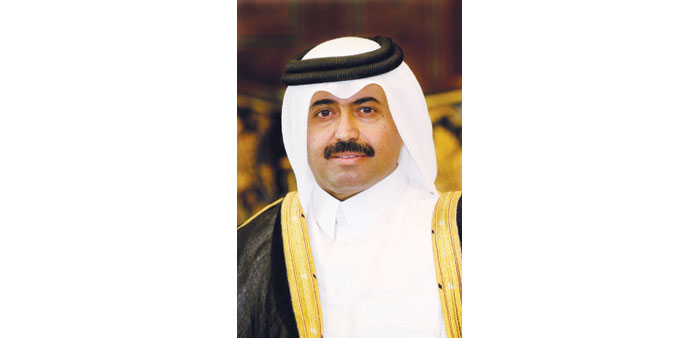
Al-Sada: Growth-oriented.