


By Santhosh V Perumal
Qatar’s retail sector, which has a total of 10 new malls at various stages of construction and another three-four at the planning stage, ought to look “stable” in the short-to-medium run, according to Al Asmakh Real Estate Development Company (Aredc).
With Qatar’s secured status as the world’s richest country and ever increasing per capita income translating into higher disposable per capita income, the inclination is, thus, towards shopping and eating out, higher than the other GCC (Gulf Co-operation Council) countries, Aredc valuation and research department said.
Owing to this reason, retailers within malls and hypermarkets have been doing well and are comfortable to pay monthly rents without compromising their locations, it said, adding fashion and luxury stores contribute about 38% of overall space within a mall.
“Overall, the retail segment (which has entered the recovery mode of business cycle) in short-to-medium run looks stable. Upcoming supply, which is likely to be delivered in the next two-five years, may impact pessimistically in the organised retail segment in the longer term,” it said.
Hypermarket, souqs and retails shops may not experience much change in rents and occupancies, the report, however, added.
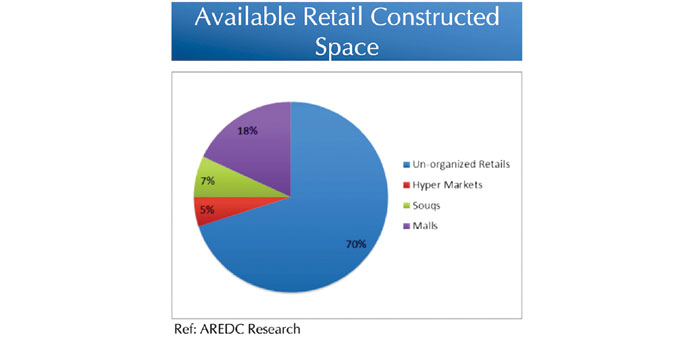
Within Qatar, the retail market can be segmented into four basic zones: malls, souqs, hypermarkets and unorganised shops, the report said, adding unorganised retail secures 70% of total retail space, although, no further supply can be expected as per the Doha town planning scheme.
The top three malls – Villaggio, City Center and Landmark - secure almost 50% of overall shopping activities among the mall segment, according to the report.
For grocery and day-to-day shopping, hypermarkets are preferred over malls. Hypermarkets such as Lulu, Safari Mall, Family Food Center and Grand Mall have been doing very well in terms of attracting foot falls. Hypermarkets comprise of around 158,000 sq m, which is nearly 5% of total retail supply.
“Approximately 550,000 sq m net leasable area is expected to be delivered on and near Al Shamal Road. This is 53% of expected supply and 96% of existing net leasable area of 13 operational malls,” it said.
Demand driving factors such as stabilised occupancy rate and rentals in malls play vital role in organised retail segment, the report said.
Qatar has clear a classification on retail shopping experience. Salwa Road and Barwa Commercial Avenue are preferred for larger establishments such as car and furniture showrooms. These areas offer better parking facilities for visitors which is unlike most parts of Doha.
Areas such as C and D Ring Roads, Al Sadd, Bin Mahmoud and Al Nasr comprise branded retail shops whereas Old Town Area is for budget stores.
The report found that the traditional concept of glamour and residential locations for retail has changed after the opening of Grand Mall Hypermarket.
Highlighting that all prominent malls have perpetual commitments from their existing occupants, which translate into high occupancies; Aredc research wing said owing to this, rentals across all malls have remained virtually “stable” since 2011.
Villaggio, City Center and Landmark commands premium in rental rates; the average rent may fetch QR 280 per sq m per month. However, rents in other malls are in the range of QR200 to QR250.
In terms of retails shops, the highest rental can be seen in Al Sadd with an average of QR250 per sq m per month, while C Ring Road and Salwa Road may fetch an average rent of QR200.
Old Town, where several shops have been rented out to a single tenant since more than 20 years, the average monthly rents are in the range of QR150 – QR180.
Qatar inflation stands unchanged in November despite rent gains
Increase in rents was negated by cheaper food, transport and miscellaneous goods as Qatar’s inflation stood unchanged month-on-month in November this year, according to official figures.
The country’s cost of living, based on consumer price index (CPI), was, however, up 2.8% year-on-year (y-o-y) on higher rents and costlier food, furniture and entertainment, the Ministry of Development Planning and Statistics figures revealed yesterday.
According to the International Monetary Fund, Qatar’s average inflation is slated to be 4%-5% in the medium term; while Bank of America Merrill Lynch expects it to “mildly harden” this year and in 2014.
The rent, fuel and energy group, which is the most influential and carries the maximum weight of 32.2% in the CPI basket, recorded the maximum increase of 5.6% y-o-y in November 2013. The index was up 0.7% from the previous month’s level.
After eliminating the effect of rent, the overall index was up 0.3% from the previous month’s level and it “showed an increase of 1.8% when compared to November 2012,” said a spokesman of the Qatar Statistics Authority, which released the figures.
The Qatar Economic Outlook 2013-14 update recently said inflationary pressures are “unlikely” to subside in 2014 but measures to curb abuses of market power in local consumer markets are expected to help keep price rises in check.
QNB recently said the country’s inflation is expected to rise moderately to 3.6% this year and 3.8% in 2014 as higher infrastructure spending will result in a large inflow of workers, putting pressure on housing and prices.
An EC Harris report had said Qatar’s construction inflation could peak to 18% during the World Cup building boom between 2016 and 2019.
Transport and Communication, which has a weight of 20.5% in the CPI basket, saw its index gain 1.9% y-o-y in November this year. However, it was down 0.2% from the previous month’s level.
The food, beverages and tobacco segment, which has a weight of 13.2% in the CPI basket, saw 2.6% acceleration y-o-y in November 2013. The index fell 0.7% from October this year.
Entertainment, recreation and culture, which carries a weight of 10.90% in the CPI basket, saw its group index shoot up 4.4% compared to November 2012 but reported a 0.2% fall from the previous month’s level.
Furniture, textiles and home appliances, which has a weight of 8.2% in the CPI basket, saw its group index surge 4.2% y-o-y, while it was down 0.2% from October 2013.
The garments and footwear group, which carries 5.8% in the CPI basket, saw their price rise 0.3% y-o-y in November this year and 0.2% against the previous month’s level.
The medical care and medical services group, which has a 2% weight, reported a 2.1% increase y-o-y in November 2013. However, the index was unchanged compared to the previous month’s level.
Miscellaneous goods and services, which carries 7.2% weight in the CPI basket, saw its group become cheaper by 5% y-o-y in November 2013. The index fell 0.5% from the previous month.