Internews/Islamabad
At the age of 40, Abdul Rahim Jan earns a meagre income of Rs9,000 a month selling potatoes off a pushcart in the dusty Nawan Killi area of Pakistan’s southwestern provincial capital of Quetta.
“I cannot pay school fees or buy costly books for my children,” he said.
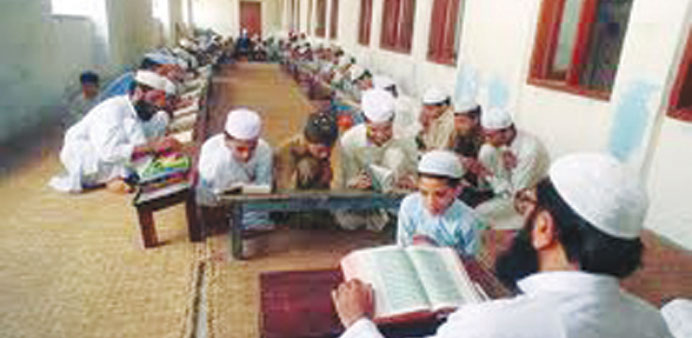
So his nine-year-old son and seven-year-old daughter study in two seminaries.
“The madrassas provide free religious education and food to them,” he says.
In Baluchistan, there are thousands of families like that of Rahim Jan, pushed by a combination of religious, political and social factors into sending their children to madrassas. The madrassa network, which is widely accused of recruiting ‘jihadis’ and financing militancy, is not just spreading rapidly here but is also actively discouraging formal schooling.
Yet where the religious-right is manipulating the situation, the government’s shortcomings are glaring, too: over 10,000 settlements across Baluchistan have no schools at all, and the province has 2.3mn children out of school.
The Baluchistan government has passed a bill declaring education free and compulsory under Article 25(a) of the constitution. Yet even those who could be in a position to improve matters present an alarming picture.
Sardar Raza Mohamed Bareech, for instance, is the adviser on education to the provincial chief minister. “Can you believe that there’s a high school for girls in the heart of Quetta that has no functioning toilet”? he asks.
The institution to which he refers has more than 2,500 students. In Bareech’s view, “we need to recruit some 60,000 new teachers and open about 13,000 new schools” to meet the target of educating all of Balochistan’s children.
Figures available with the provincial education department show that there are 57,000 teachers employed in 12,600 primary, middle and high schools in Baluchistan. But the provincial secretary for education, Ghulam Ali Baloch, says that there are more than 2,000 ‘ghost’ schools with around 4,000 ‘ghost’ teachers institutions and educationists that are dysfunctional or exist solely on paper.
Independent sources and educationists put these numbers even higher: well-known educationist Nazar Mohamed Bareech, for instance, claims that there are more than 10,000 ‘ghost’ teachers.
Meanwhile, according to Ghulam Ali Baloch, almost half of the 22,000 settlements across the province have no schools at all.
In the absence of schools, madrassas have mushroomed in Quetta and in other parts of the province.
After the events of 9/11, when Pervez Musharraf decided that all seminaries across the country must be registered, in Balochistan the task fell to the Department of Industries and Commerce.
An officer of this department said on the condition of anonymity that around 2,500 madrassas are registered with the Baluchistan government, and the number of unregistered seminaries lies at more than 10,000. “Most of them are located in the areas bordering Afghanistan,” he said.
As in other parts of the country, Islamic fundamentalism in Baluchistan can be traced back to Ziaul Haq’s ‘Islamisation’ policies.
But the US-led invasion of Afghanistan in the wake of 9/11 contributed significantly to boosting radicalisation in the Pakhtun-dominated areas of the province.
Madrassas have been used to recruit fighters and finance militancy. But they also provide accommodation, clothes, food and books to their students, a lure that poor people, especially in isolated areas, find attractive.
Yet the challenges thrown up by religion, poverty and other factors could be countered if only there were sufficient government schools.
Educationist Zubaida Jalal, a former federal minister for education, believes that “the government has failed to educate children.”
She maintains that it is a myth that the sardars, or feudal lords, are an obstacle in the way of education in this province, and feels that poverty and unemployment are yet to be addressed here. “These issues are a hundred% behind the radicalisation,” she says.
Cumulatively, the situation is such that the demand for madrassas in Baluchistan seems to be increasing