


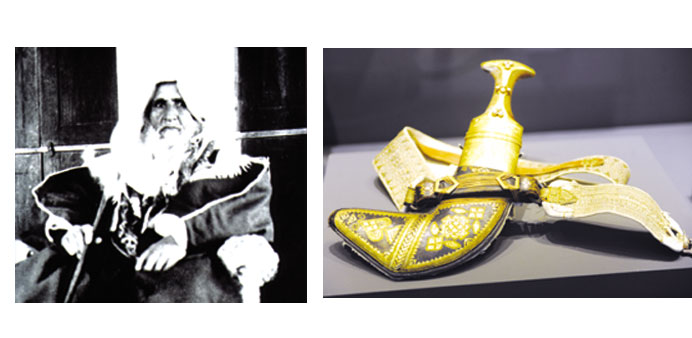
Sheikh Abdullah bin Jassim al-Thani. Right: A dagger belonging to Sheikh Abdullah bin Jassim al-Thani dating back to the mid-20th century is a part of the exhibition. The Arabic style dagger has a steel blade and an ivory handle covered with gold plaques and pearls. The sheath is embroidered with silk and gold thread. PICTURE: Noushad Thekkayil
An exhibition at Katara takes viewers back in time to the beginnings of the modern history of Qatar with a focus on one of the most influential leaders of the country.
Open until January 30, 2014, the exhibition, “Sheikh Abdullah bin Jassim al-Thani - A Leader’s Legacy (1913 – 1949),” being held at the Qatar Museums Authority Gallery in Building 10, explores the era of Sheikh Abdullah who oversaw the advent of Qatar’s petroleum industry, education and hospitals, infrastructure and the transformation of Doha.
Featuring historic artefacts, photographs, oral history interviews, and original films, the exhibition organised and curated by the National Museum of Qatar with ExxonMobil as the principal sponsor, presents new insights into Sheikh Abdullah’s life and legacy to Qatar’s people.
Sheikh Abdullah bin Jassim bin Mohamed al-Thani (1871-1957), was first appointed as governor of Doha in 1905 and held this position until the passing in 1913 of his father, HH Sheikh Jassim bin Mohamed bin Thani, considered the founder of Qatar.
Ruling between 1913 and 1949, Sheikh Abdullah bin Jassim’s personal and leadership qualities, as well as his wisdom and intellect played a prominent role in the economic and political expansion of Qatar.
His foremost achievement took place immediately after he ascended to authority during the Anglo-Ottoman convention in 1913 at which time the Ottomans renounced any claims that they had on Qatar, thus terminating their presence on the peninsula. The convention also recognised that Al Zubarah rightfully belonged to Qatar.
Sheikh Abdullah bin Jassim signed a treaty with the British in 1916 which recognised him as the Ruler of Qatar. This treaty also ceded the conduct of Qatar’s foreign affairs to the UK and placed the country under British maritime protection. Oil was discovered in 1939, and was one of the main contributors to Qatar’s rapid economic development.
During his time as ruler, Sheikh Abdullah bin Jassim gained the love and loyalty of his people through his commitment to improving their quality of life. His role in transitioning Qatar into a new phase of its history was one that was pivotal.
Sheikh Abdullah bin Jassim was instrumental in regulating pearling. He demarcated the pearling season and established the dividend rates of the workers on the pearling dhows.
He managed the country’s internal affairs in a graceful manner and reduced any possible external intervention despite the difficulties that he endured.
His character and abilities made him a great leader for the people of Qatar for more than 37 years.
Admission to the exhibition is free. The timings are from 9am to 8pm Monday to Thursday and on Saturday. On Friday it is open from 3pm to 9pm. The exhibition is closed on Sunday.