


Bloomberg
Mumbai
|
|
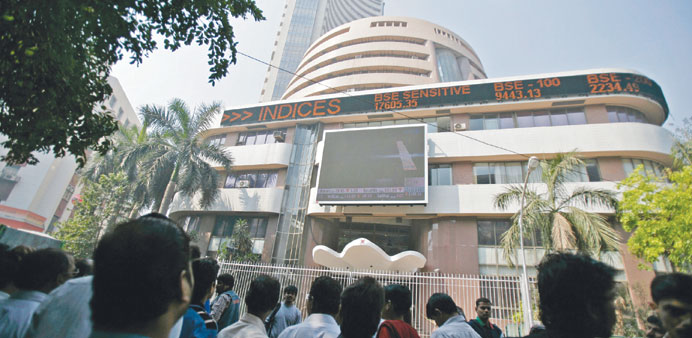
India’s benchmark equity index rose to a one-week high, led by businesses sensitive to borrowing costs such as capital goods and real estate, after the central bank unexpectedly refrained from raising interest rates.
Bharat Heavy Electricals, the largest maker of power equipment, posted the biggest gain in three months. DB Realty surged 7.7%, helping a gauge of developers jump the most in two months. Reliance Industries had the sharpest advance in a month.
The S&P BSE Sensex increased 1.2% to 20,859.86 at the close, ending a six-day retreat.
Governor Raghuram Rajan left the repurchase rate at 7.75%, a move predicted by only five of 31 economists surveyed by Bloomberg. Indications that vegetable prices may fall, combined with a more stable exchange rate and lag effects from the previous rate increases give reason to hold borrowing costs even though inflation is “too high,” the central bank said in a statement.
“Rajan is saying that he has some reason to believe that food prices will come down in the near future, and if they don’t he will have to take a harsh decision,” K R Bharat, managing director of Advent Advisory Services in Mumbai, told Bloomberg TV India yesterday. “He is giving this idea of his a chance. The market has no complaints at all with what he has done.”
Bharat Heavy had the biggest gain since September 25. Larsen & Toubro, the nation’s biggest engineering company, rose 2.7%. Reliance climbed 2.5%. Tata Power jumped 4% to a five-month high, while GAIL India added 2.5% and Oil & Natural Gas Corp advanced 2.4%.
DB Realty had the sharpest gain in two months, helping the S&P BSE India Realty Index jump 3.5%, the most among the 13 sectoral indexes compiled by the BSE. Housing Development & Infrastructure rallied 7%, the second-biggest gainer on the property index.
State Bank of India advanced the most in three weeks to Rs1,763.40, halting a six-day, 9.1% drop. Mortgage lender Housing Development Finance Corp rallied 2.5% to Rs798.25. Canara Bank and Bank of India rallied more than 5%.
Rajan’s decision comes ahead of a US Federal Reserve announcement later yesterday on whether to start curtailing $85bn in monthly bond purchases that’s increased flows to emerging markets.
Global funds have bought a net $18.9bn of Indian shares this year, the most in Asia after Japan, data compiled by Bloomberg show.
The RBI will act, possibly between policy meetings, if inflation doesn’t ease, the central bank said. Yesterday’s policy decision was “a close one,” the monetary authority said.
India’s wholesale prices rose in November at the fastest pace in 14 months and consumer prices gained the most in data going back to January 2012, official figures showed in the past week. A separate report showed industrial production contracted in October by more than economists had predicted. Economic growth of 4.8% in the three months ended September was below 5% for a fourth quarter.
Rajan, who boosted costs twice since taking office in September, said December 11 that the monetary authority is “very uncomfortable” with current level of inflation.
The Sensex has climbed 7.4% this year, the best performer among the four largest emerging markets, and trades at 13.5 times projected 12-month earnings, compared with the MSCI Emerging Markets Index’s 10.4 times.
The CNX Nifty Index gained 1.3% to 6,217.15. The India VIX, a gauge of options prices, fell 4.3%.
Meanwhile, India’s rupee weakened after the central bank unexpectedly refrained from raising interest rates.
The rupee dropped 0.1% to 62.1050 per dollar in Mumbai, after rising as much as 0.4% earlier, according to prices from local banks compiled by Bloomberg. The currency has gained 0.6% this month and has rebounded from a record low of 68.845 touched Aug 28.
“To me, Rajan has lost a lot of his credibility,” said Dariusz Kowalczyk, a strategist at Credit Agricole CIB in Hong Kong. “His credibility has allowed the rupee to move from around 69 to 61 and now that the action is inconsistent with last week’s comments I think the rupee will come under downward pressure in the near term.”
One-month implied volatility in the rupee, a gauge of expected moves in the exchange rate used to price options, fell eight basis points, or 0.08 percentage point, to 11.30%.
Three-month offshore non-deliverable rupee forwards fell 0.1% to 63.17 per dollar, according to data compiled by Bloomberg.