


|
Concerns among Hispanics that signing up for medical insurance under President Barack Obama’s healthcare law may draw the scrutiny of immigration authorities has hurt enrolment, according to advocates of the policy. |
Convincing Latinos to enrol could be crucial to the law’s success, and supporters of Obama’s signature domestic policy are aiming their campaign at the 10.2mn Latinos eligible for the new insurance plans or the expansion of the Medicaid programme for the poor.
As a group, Latinos are younger than the overall population in the US and signing them up in large numbers under the Patient Protection and Affordable Care Act could help offset the costs of covering older and sicker people.
But the enrolment effort appears to be falling short.
In California, home to the largest Latino population in the country, only 13% of enrollees on the state’s online marketplace called Covered California identified themselves as Hispanic, despite accounting for about 38% of the population, the state said last week.
Ironically, polls have consistently shown Latinos are more supportive of the law, commonly called Obamacare, than the general public.
A September survey from the Pew Research Centre found that 61% of Hispanics had a favourable view of the law compared to 29% among whites.
The law, passed in 2010, established online insurance exchanges, or marketplaces so that millions of uninsured people could enrol for private healthcare plans.
The Obama administration has not released figures on enrolment by ethnicity, but so far officials are not optimistic about Latino turnout.
“I would not be surprised if those numbers aren’t what we want them to be right now,” said Mayra Alvarez, associate director of minority health at the US Department of Health and Human Services.
The sign-up campaign may be stalling in part due to the administration’s vigorous enforcement of immigration laws.
The administration deported a record number of people during Obama’s first term, according to Pew Research Centre data.
While Obama has backed a bill that offers a pathway to citizenship for many of the country’s 11mn undocumented immigrants, his administration increased deportations to nearly 410,000 people in 2012, almost double the number in 2003.
Obamacare supporters say fear of immigration enforcement is a particular concern in Hispanic families where one spouse is a US citizen or legal resident and married to an undocumented person, or where both parents are undocumented immigrants but their children have citizenship.
“A lot of mixed-status families are afraid that if they enrol, that the government will come and divide up their family through deportation,” said Daniel Zingale, senior vice-president at the California Endowment, a health foundation.
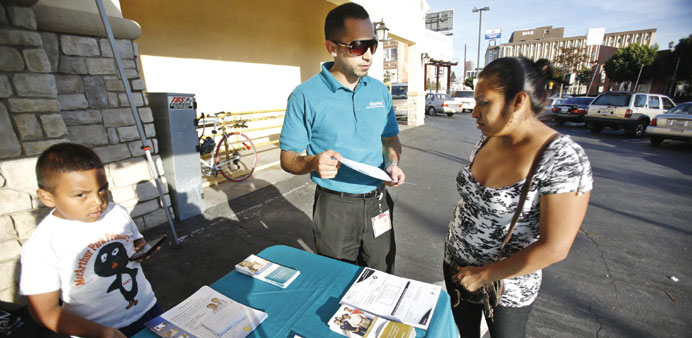
One couple who last month came to a Los Angeles event by the group Vision y Compromiso demonstrates the types of problems these families face, said program manager Hugo Ramirez.
The undocumented parents, a father who is a construction worker and a mother who works as a house cleaner, feared information they might submit to enrol their three children in Covered California could be used against them by US immigration officials, Ramirez said.
An advocate advised the couple that they would not risk running afoul of immigration authorities, but that in enroling their children and providing details on the family’s earnings, they would have to begin paying income taxes despite being undocumented, Ramirez said.
The administration has sought to defuse immigration concerns, which had been flagged by community leaders before the six-month open enrolment period began on October 1.
The US Immigration and Customs Enforcement agency said in October that personal information submitted by insurance shoppers would not be used for immigration enforcement.
Minnesota’s exchange, MNSure, said it has found that even when mixed-status Latino families were prepared to sign up, some hesitated in submitting information needed to verify the identity of the member seeking insurance online.
“This is on our radar and we are communicating with our navigators about this issue,” said MNSure spokeswoman Jenni Bowring-McDonough.
When it comes to enrolment, technology issues have also proven a barrier.
The Spanish-language version of the federal online exchange, CuidadoDeSalud.gov, was not running until December.
The federal website, HealthCare.gov, which serves 36 states, was hobbled by technology problems in October and much of November and fell short of enrolment expectations.
Latino families, because of lower household income and other factors, are less likely to have home Internet connections, according to a 2013 Pew Research Centre study, making them more dependent on outside help from enrolment navigators to shop for the new plans.
Ricardo Hernandez, 20, a Los Angeles-area resident, is uninsured and eager to obtain coverage, but he lives with his sister in a house that has no Internet connection.
The troubles seen in California run even deeper in Florida and Texas, two states with large Hispanic populations. Both states declined to set up their own websites and shoppers need to use the federal government portal.