


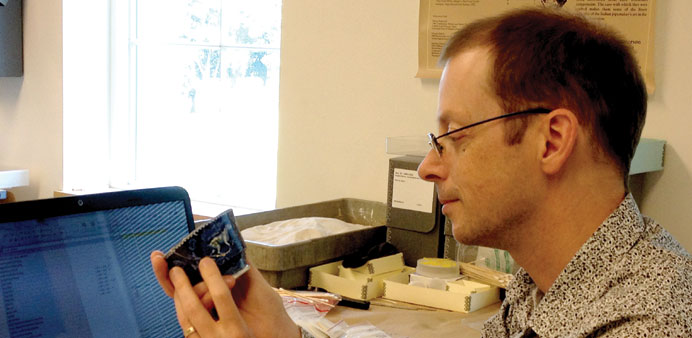
MUCH TO LOOK FORWARD TO: Dr Alasdair Brooks says the complete sequence of pottery styles at Al Zubarah will help date archaeological deposits more accurately.
—Archaeological field manager Dr Alasdair Brooks on the importance of Al Zubarah
The recent unveiling of Al Zubarah as Qatar’s first UNESCO World Heritage site is the culmination of years of hard work by the Qatar Museums Authority, archeaologists from around the world and companies like Maersk Oil Qatar.
Dr Alasdair Brooks, the archaeological field manager with the team from the University of Copenhagen working at Al Zubarah alongside the Qatar Museums Authority, talks to
Q: Firstly, why is Al Zubarah such a unique and important site?
There’s plenty of evidence of Al Zubarah’s involvement in the pearling industry — we’ve found divers’ weights, the remains of a pearl merchant’s chest, even an oyster shell complete with a pearl! Through the international trade network pearls were exchanged for a wide range of goods. And not just pearls, there was clearly a trade in exported dates, imported from neighbouring regions and processed. The spread of broken ceramics beside the date presses includes some from Iran and China, showing how extensive was the trade network. Al Zubarah is particularly important because it was the first truly independent Arabian pearling centre that was entirely free of the control of outside powers, such as the Persian and Ottoman empires.
Can you tell us, what’s been happening in your most recent season?
This season we’ve been focusing in two areas, a souq and the area we call the palatial compound. At the souq, our goal is eventually to join up the excavations undertaken by the University of Copenhagen with those carried out by Qatari archaeologists in the 1980s. This season we’ve uncovered the remains of no fewer than twelve date presses at the souq! It suggests that this area was either a warehouse district or a concentration of light industry, dating from the 18th century, the time of the greatest expansion of the settlement. Each date press has an area where the dates were piled up and the date syrup [dibs] drained down channels into a sunken collecting jar. At first we weren’t sure if this area was part of the souq – but it’s not unusual, just as it is today, to find a concentration of similar activities in a market.
To get down to the original settlement of the period from the 1760s to 1811, when the town was at its busiest, we first have to go through all the layers of occupation. Over the last five years we’ve looked at the brief occupation of Al Zubarah in the second half of the 19th century, then underneath that there’s a period from 1811 to the mid-19th century, and that layer often takes a long time to excavate as there is evidence of temporary structures: palm frond and barasti huts, tents, that kind of thing. This phase is tricky to excavate because all the evidence has to be collected for the ephemeral occupation. Once that level’s taken down you get to the original pre-1811 layer. This is when Al Zubara was at its peak of occupation: it’s estimated that between seven and nine thousand people lived there.
You mentioned a palatial compound—sounds interesting!
Yes, our other main site this season is the so-called palatial compound beside the town wall which consists of nine associated compounds adjacent to each other. So far we’ve only worked on one of the sub-compounds and that’s taken us five years! We’re just finishing in this area and our building conservation team is busily working alongside the archaeologists. We’ve also been excavating a narrow corridor between two of the compounds. One room is quite extraordinary for the massive amount of pitting beneath the occupation layer. In some places there’s no original surface left, just a sequence of pits that have been repeatedly cut through and filled in. Some are so deep that they go right down to the water level! Our current primary hypothesis is that these pits are related to the original structure and may have been used as a source of gypsum and shelly material for construction.
In an adjacent sub-compound, we’re recording and preserving etchings of sailing vessels on the plaster walls. Most are of dhows, which you’d expect, but there is one which appears to be of a square-rigged European vessel.
What are your and Qatar Museum Authority’s long-term goals in excavating Al Zubarah and researching its history, apart from making it accessible and better known to the public of course?
Broadly speaking, we’re all working together in attempting to answer questions such as how Al Zubarah was formed, and how it changed over time. We want to find out how the sites were constructed, including the palace compound, the souq and the outer wall. Understanding how the town was formed will tell us a lot about the dynamics of settlement patterns of the period and how these settlements adapted to changing conditions. We’re also looking at the daily life of the citizens of Al Zubara: the objects they used, such as glass, ceramics and jewellery. We’re finding out quite a lot about their food for example, and we have specialists working on all these topics. We’ve even got an archaeologist on site whose special expertise is in shells!
Is it true that Maersk Oil Qatar has made their Digital Core Laboratory in Doha available for research by archaeologists and it that being used to study objects from Al Zubarah?
Yes, it certainly is. Our pottery specialist is coordinating with scientists from Maersk Oil to make ultra-thin cross-sections of ceramic vessels to study the mineralogical content. This is extremely useful because you can look at the type of clay and the inclusions in it and that gives you information about where the pottery came from. This, in turn, helps us to understand the role played by Al Zubarah in regional and intercontinental trade. Of course, specialists in ceramics can usually tell by looking at its style what region a piece of pottery comes from and also the date – which in the case of Al Zubarah is evident from the context – but the Digital Core research at the Maersk Oil Research and Technology Centre goes a lot further and can identify the specific point of origin of a piece.
Eventually, the data from Maersk Oil’s lab will help us to make a complete sequence of pottery styles at Al Zubarah, and this will help us date archaeological deposits more accurately. Our pottery specialist has been really enthusiastic about the fantastic results we’ve been getting so far.
What future plans does the Qatar Museums Authority have for the Al Zubarah archaeological site?
The ‘modern’ Zubarah Fort, built in 1938, has been carefully restored and will become the main visitors’ centre, with displays and interpretive panels. Down at the archaeological site there’ll be a walking trail laid out from the car park with interpretive signboards in English and Arabic. Visitors will be able to walk between the main excavated and conserved archaeological sites and see interpretive displays about Al Zubarah’s history and its environment. Meanwhile, a temporary exhibition, which began Friday, will remain open to the public for about six months. Exhibits in the temporary exhibition will be rotated, but once the exhibition is set up in the fort it will be permanent.
Commenting on the inauguration of the Al Zubarah archaeological site to the UNESCO World Heritage List, Professor Thomas Leisten, Chief Archaeology Officer at QMA, said, “We’re expecting that the opening of the site at Al Zubarah will have a catalytic effect in creating awareness of their roots among the people of Qatar.
This is the first opening in this country of an archaeological site that has the qualities to attract the general public rather than just scholars. People visiting Al Zubarah will be helped to understand its historical importance by the displays in the museum, and there’ll be a UNESCO plaque naming Al Zubarah as a World Heritage Site, which means it’s not only unique but recognised as of international value.”
“In fact,” Professor Leisten went on to say, “there is no other site like it in the world. Al Zubarah is the first of many archaeological sites that will be developed by QMA around the country — the northern villages for example, and the Barzan Tower. In doing so we’ll be opening up Qatar’s past to the public.”