


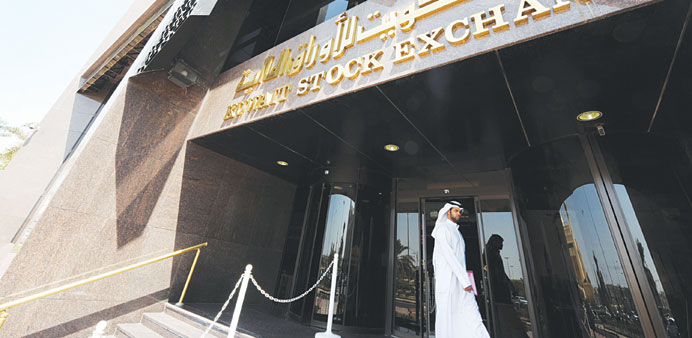
An investor exits the Kuwait stock exchange in Kuwait City (file). The UAE and Qatar were recently upgraded to MSCI emerging market Index, which fuelled discussions about the viability and possible timeframe for Kuwait and Saudi Arabia to be included in the same way.
Debt markets in Mena are largely underdeveloped and widely characterised by lack of trading in secondary market, says Kuwait Financial Centre (Markaz) in a report.
Primary market issues are “tilted towards long-term maturity, promoting buy and hold strategy”, which in turn has led to “shallow” secondary markets.
Issuing government securities at regular intervals across maturities would help in establishing sovereign yield curve and further help to properly price risk for private issues.
Market liquidity, which averaged $140bn in the past four years (2005-2008) preceding global financial crisis, slumped to an average value of $32bn in the next four years (2009-2012).
The relative halting of lending played a large part in declining liquidity, as earlier to financial crisis availed credit was funnelled to purchase securities. The average annual growth in loans during 2004-2008 was 29%, reaching a high of 38% in 2007, fell subsequently to single digits. Also, the retail investors who constitute the bulk of market participants are undergoing their own state of de-leveraging post the global financial crisis.
A Markaz report shows Mena asset management industry, which currently manages approximately $62bn in assets in about 782 funds has been in the doldrums post global financial crisis with Assets under Management (AuMs) steadily declining. AuM/GDP ratio for half of the Mena countries was less than 0.5%, implying lack of mutual fund penetration as an investment option.
The Mena asset management market is concentrated among the top asset management companies, with the top 10 asset managers (out of a total of 174 managers) accounting for over half of the total assets being managed.
Lack of avenues to participate in the economic growth story, political risk and the resultant volatility has made the task of raising funds a challenge. Broad basing the equity market, enhancing the participation of institutional investors and opening up ownership to foreign participants would help to tide over the problem and improve industry AuMs.
According to the report, the “carnage of global financial crisis is still felt with weak economic growth in most developed economies and uncertain outlook. Investors who got badly bruised did not just lose their capital but also the trust which they had in their advisers.”
While the global AuMs have been stagnant for the past four years, AuMs in Mena region has witnessed steady decline over the years. Sovereign wealth funds are massive in size and too large for Mena markets and investing locally would not help their cause in achieving diversification.
Ultra high net worth individuals (UHNI’s) are a niche group who are predominantly served by private bankers. The retail clients are a polarised group, they either trade aggressively or shun markets altogether and invest in bank deposits.
The UAE and Qatar were recently upgraded to MSCI emerging market Index, which fuelled discussions about the viability and possible timeframe for Kuwait and Saudi Arabia to be included in the same way.
Foreign Direct Investments (FDIs), which have been the game changer for many markets, can bring with them a host of changes and greatly institutionalise the market. However, foreign investments in GCC stock markets have remained on sidelines so far and much needs to be done to attract them.
Disclosing timely and comprehensive information in English would be a good start. Expediting corporate governance measures, strict enforcement and adherence to accounting standards, standardised corporate announcements and guidance from management would help better understand the business and would result in efficient markets, benefitting all in the long run.
Innovative measures such as unifying stock exchanges could help in increasing market liquidity, limiting volatility, enhancing confidence for market participants and consequently can provide an attractive destination for international institutional investors.