


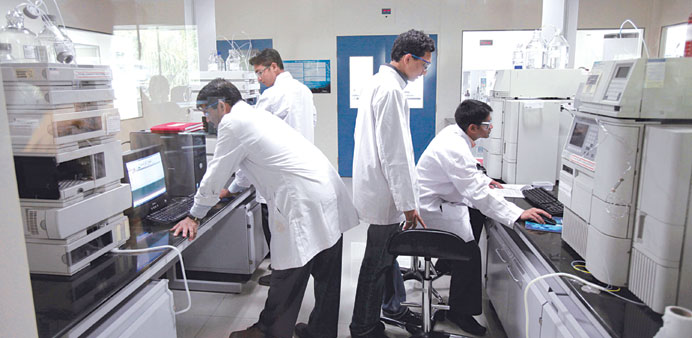
GlaxoSmithKline Pharmaceuticals employees work in a research and development facility in Nashik, India. The pharmaceutical major yesterday said it has decided to spend roughly $1bn to raise its stake in its Indian unit.
Reuters
GlaxoSmithKline Plc (GSK) has decided to spend roughly $1bn to raise its stake in its Indian pharmaceutical unit, betting on rising demand in emerging markets as sales in developed economies slow due to a wave of patent expirations.
With the latest India deal, GSK is set to spend close to $2bn in roughly a year to increase its holdings in two listed Indian companies, its biggest incremental investment in any country in that period.
Emerging markets such as India and Brazil are an important plank of GSK Chief Executive Officer Andrew Witty’s growth strategy, as he grapples with slower uptake of the company’s products in the developed world.
GSK said yesterday it plans to raise its stake in its Indian pharmaceutical unit, GlaxoSmithKline Pharmaceutical, up to as much as 75% from 50.7% through an open offer in a deal worth about 629mn pounds ($1.02bn).
In February, GSK lifted its stake in its publicly-listed Indian consumer healthcare subsidiary, GlaxoSmithKline Consumer Healthcare, to 72.5% from 43.2% for $901mn.
“What they are trying to indicate that this market can reward them nicely in the future,” said Sarabjit Kour Nangra, a sector analyst at Angel Broking. “India is a growing market and GSK cannot afford to lose its hold.”
Western drugmakers like GSK, Pfizer, and AstraZeneca , covet a bigger share of India’s fast-growing $13bn drugs market, but have been frustrated by a series of decisions on intellectual property and pricing.
India in August revoked a patent granted to GSK for its breast cancer drug Tykerb, a decision that followed a landmark court ruling disallowing patents for incremental innovations that was a blow to global pharmaceutical firms.
Despite the challenges, western drugmakers have been looking to raise their exposure in Asia’s third-largest economy betting on an increase in healthcare spending. India currently spends about 5% of its gross domestic product on healthcare.
“This really reflects the opportunity we see here in India, particularly the volume opportunity,” said David Redfern, chief strategy officer of GSK, referring to the company decision to raise stake in the Indian unit.
“We have a broad range of medicines and vaccines and we really think over the next few years as India develops we can drive a substantial increase in volume to make more medicines and vaccines available to the Indian population.”
The deal adds to the growing list of multinational companies raising their holdings in the local units as they look to reduce their reliance on traditional markets even as the Indian economy grew at its slowest pace in a decade in the last fiscal year.
Anglo-Dutch consumer goods company Unilever in July completed a deal to raise its stake in the Indian unit Hindustan Unilever to 67.28% from 52.48% in a deal worth about $3bn.
GSK will buy up to 20.6mn shares of GlaxoSmithKline Pharmaceutical at Rs3,100 a share, a premium of 26% over its closing market price on Friday. The stock rose as much as 20% yesterday to Rs2,952.15.
Nangra of Angel Broking said that the premium was attractive for investors who were planning to exit the stock in the near term, but long-term investors were likely to remain invested on future growth potential of the company.
GSK said that it planned to keep the Indian unit listed even after raising its stake. As per Indian regulations, promoters of listed companies can hold up to a maximum 75% stake. If the promoter’s shareholding rises beyond 75%, the company has to be de-listed from the bourse.
The deal will be funded by GSK’s existing cash and will be earnings neutral for the first year and accretive thereafter, the company said. The tender offer will not impact expectations for the parent’s long-term share buyback programme, it said.