


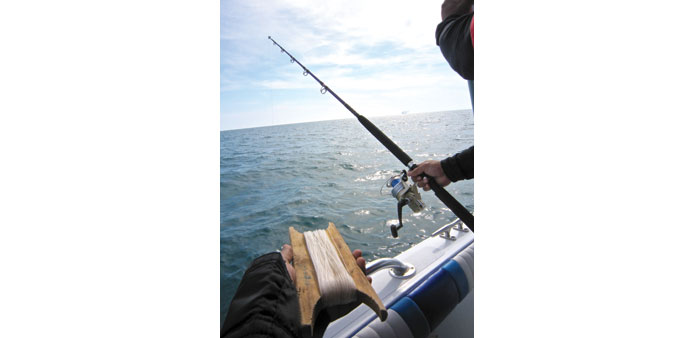
Fishing is a great way to enjoy the sun, sea and good company.
The bonus is when you hook some fish as Jay Jayaraj finds out
|
|
For a man who loves fishing, both deep sea and inland, Troy Benoit wasn’t a big fan of seafood for a long time.
The 40-year-old from Nova Scotia, Canada, preferred any other animal meat over fancy fish despite having gone for many fishing trips at home with his family while growing up.
Over the years, however, he has managed to cultivate a taste for some variety of fishes while staying within his safe choices. Today, he has moved on from just fish-and-chips and canned tuna to more exotic seafood like sushi and lobsters, with tuna and haddock as favourites.
“It’s really specific though. If I’m going to have a meal with sides and salad, then probably a nice haddock is great but if I’m having something else like sushi, tuna is my favourite. I don’t know if I really like mackerels. I had stingray in Singapore once and for me it was horrible, the chewy bone texture.
Recalling a work travel via a ship from Australia to New Zealand, Benoit says they caught some nice Maui Maui and yellow fin tuna.
“The Filipino crew made sashimi out of them, it was fantastic. I like white fish or anything that’s mild in flavour and I stay away from strong tasting fish like salmon. If I come across bad seafood, it puts me off and I don’t eat fish for a year,” says Benoit, who is a supervisor with an offshore drilling company in Qatar.
To each, his own. Benoit still loves fishing and actively goes on fishing trips with his family and friends. Over the years, he has been fishing at several locations around the world including New Zealand, Mexico, Dominican Republic and Bermuda.
He says the biggest fish he has caught is a species of Jake during a fishing trip in Bermuda at 16. Fishing, Benoit says, is a nice activity that allows quality time with family and friends. It’s a great way to enjoy the sun, sea and good company and the bonus is when you hook some fish.
“We try to go fishing whenever we travel, especially when I’m with family; it’s a nice way to spend time with them. I bonded with my dad through fishing in lakes,” he adds.
Back in Nova Scotia, fishing is done even during winter through ice-fishing. In this case, a hole is made using a chainsaw on a lake that has frozen solid and fishing is done with a fishing line.
“My grandpa used to take us all the time. There is also something else to do there that they don’t normally do in all other places. It’s called eel raking. They cut long trenches in the ice, maybe six of them, next to each other and they put in long metal rake in it and drag it along the line and when they pull it up, there are eels,” explains Benoit.
Recently, Benoit and his wife Pam Austin, 40, were on a fishing trip when his family was down in Doha for a visit. There aren’t any lakes in Qatar, so the only other option is the sea.
Deep-sea fishing in the Qatari waters is quite a popular activity among fishing enthusiasts. There are several companies that offer fishing charters and they come in different packages.
Fishing licence is not needed for recreational fishing and only fishing vessels require licencing in Qatar. Fishes found here include grouper (hammour), sherry, seabass, tuna and sharks. Although some may argue about the Gulf not having the depth for deep sea fishing, it’s still an exciting activity for anglers. The Gulf averages between 30m and 40m in depth with the deepest areas at about 100m deep. The water depth for deep sea fishing should be about at least 30m deep.
Benoit isn’t too happy with the tour company he chose to go with but he would definitely go into the sea to fish again with a different company. One of the things about deep sea fishing is trolling, which is fishing by trailing a baited line from behind a slowly moving boat.
Benoit says that it’s effective anywhere in the ocean as some fish is bound to be attracted to the shiny bait.
“You can use a fish finder (an echo sounder specifically designed to detect the presence of fish in the underwater environs) to look at the layout of the bottom, elevation and depth and a trained person would be able to know if you’re fishing along the banks. The schooling fish are going to pool up and when there are schooling fish, bigger hunter fishes are going to come along to feed, too.
“Fish finders are helpful. Some of the expensive ones can tell you the type of fish that are in an area, the size and more,” says Benoit, adding that equipment from quality line, hooks and reels are important for a thrilling experience.
Benoit explains that it’s best to go fishing in the morning when the water is still cool. The cooler the water, the more active the fishes are and the warmer the water is, the more lazy they get.
“When the water is warm, some species of fish go deeper, which is why you don’t have some of the best fishing around here. The water is so warm,” he says.
During the family trip in Qatar, Benoit was told that they had chance to catch some sharks but they didn’t. Using mostly handlines in water depth between 20m and 30m, they managed to go home with some sherry, a dozen sultan and a copper in two hours, which later made a nice barbeque.
The excitement in deep sea or sport fishing is in the fight put up by a fish, specifically bigger species which are found in the deep waters.
“The challenge is in that: catching a fish that fights back. Keeping the fish for food really depends because most people I go with, they’ll catch it and eat it but sometimes it’s catch-and-release. During our recent fishing trip however, they were just small fishes. The girls got excited when they caught one but nothing big really,” he says.
Sukhvinder Singh, 48, also has been fishing for a long time. The Malaysian began fishing in the early 80s at old mining pools.
Over the years, the aircraft engineer based in Qatar, has gained much experience in his chosen hobby. Living in Qatar for two and half years, Sukhvinder has been out deep sea fishing four times with the recent trip taken last week with some friends and a visiting nephew, Sanjay Arvvindraj, 17.
During the trip, the team enjoyed the sun and speed of the boat which took them to an area which was about 25 nautical miles away from Lusail marina (east coast).
Perhaps, the weather was a bit too hot for fishing, the boat tried several spots and did a bit of trolling, before it settled at one area. The depth in these areas were around 15m to 25m.
“Fishing is a fun activity and it’s not just about catching fish. It’s about anticipation and patience. It’s also about the boat ride, being in the open sea and the company I’m with. The biggest fish I have caught while in this waters is probably a hammour.
“There have been reports of illegal fishing nets and maybe that is affecting the fish you catch here. Otherwise deep-sea fishing is about bigger targets,” he says.
Sukhvinder’s fishing buddy here is another fishing enthusiast, who is also his colleague Bob Casper, 48. The American from Texas have fished in Germany, England, Korea and all over America and have qute interesting stories from these places.
His biggest catch has been an ail fish, which weighed about 130kg while fishing in Mexico. However, Casper feels that he may have to agree with an article he read about over-fishing in the Qatari waters.
“We fished for two to three hours in our last fishing trip and have caught less than 10 fish — and they’re small ones. What does it say about fishing here then?
“I have to agree with that article I read,” says Casper, adding that his biggest catch in Qatar is a 2kg hammour.