


AFP/Tunis
A deal naming a premier-designate was met yesterday with both hope and apprehension in Tunisia, which has been in the grip of political crisis for months.
Industry Minister Mehdi Jomaa was named late Saturday by the Islamist-dominated ruling coalition and opposition to form a government of independents to end the stalemate caused by the killing of leftist MP Mohamed Brahmi in July.
Houcine Abassi, head of the powerful UGTT union that has mediated talks, said he would announce the date for Jomaa’s government to take office within days.
“On Wednesday we are going to announce the date of the inauguration of the new government,” Abassi said.
Jomaa’s nomination followed months of talks between moderate Islamists Ennahda and the mostly secular opposition, after the two sides agreed to negotiate an interim government under a road map brokered in October.
The transition still faces challenges, despite Islamist Prime Minister Ali Larayedh’s pledge to step down.
Ennahda has said the interim government due to lead Tunisia to fresh elections in 2014 can only come to office with a new constitution, a work in progress for two years, and a new electoral law.
But the local press was bullish about Jomaa’s appointment, with the Adhamir daily calling it a “new hope”.
“The choice of Mehdi Jomaa shows our great people is capable of resolving its disagreements with dialogue,” Adhamir said.
“Finally, the Mehdi has arrived,” the Attounsia daily wrote, making a pun on Jomaa’s first name, which translates roughly as the “chosen one” in Arabic.
However, daily La Presse wrote the nomination came “at the end of a desperate marathon marked by twists and turns”.
When the 21 parties taking part in the talks to choose an interim premier failed to reach a consensus on Saturday, the question was put to the vote.
One part of the opposition, notably the Nidaa Tounes party, which boycotted the vote, rejected the choice of a member of the outgoing cabinet.
Some saw the lack of consensus as proof the Islamists do not plan to relinquish power.
“Several weeks’ work has ended in a negative result, the troika (of the ruling coalition, headed by Ennahda) repeated its errors and chose a minister from the outgoing government,” Nidaa Tounes spokesman Ridha Belhaj told Mosaique FM radio.
“It is true that he is a technocrat, but everyone knows he is close to Ennahda.”
Nidaa Tounes quit the talks even before Jomaa’s nomination.
Ennahda head Rached Ghannouchi hailed the appointment as a “success for democracy in Tunisia”, adding the country would become the first in the region “to be a democratic model”.
Jomaa, a relative unknown, is a 51-year-old engineer with no stated political affiliation.
He became industry minister following the formation in March of a new government by Larayedh in a crisis that erupted following the assassination a month earlier of key opposition figure Chokri Belaid.
Jomaa’s nomination came as Tunisia prepared to mark tomorrow’s third anniversary of the beginning of the uprising that toppled dictator Zine al-Abidine Ben Ali.
The protests were sparked by a young street vendor’s immolation in the impoverished central town of Sidi Bouzid, and fanned by economic desperation and repression.
Parliament early yesterday adopted a “transitional justice” law designed to compensate victims of the regimes of Ben Ali and Habib Bourguiba, official media said.
The law was rushed through parliament after repeated delays as Ennahda and the opposition accused each other of trying to exploit the issue for political gain.
It stipulates the creation of an independent “truth and dignity body” tasked with identifying and compensating victims of abuse under the regimes of Ben Ali and founding president Bourguiba.
It also proposes to identify and bring to trial those responsible.
The bill covers “any blatant or methodical aggression perpetrated in the violation of human rights by agencies of the state, or by groups or individuals acting in its name or under its protection”.
Crimes covered include voluntary homicide, rape, extrajudicial killings and torture, as well as economic crimes such as misappropriating public funds and financial corruption.
The transitional justice system should also lead to a reform of the laws and institutions that allowed such violations, and strengthen the rule of law.
The law was adopted by 127 members of the 217-strong National Constituent Assembly just after midnight, a day after MPs began examining the draft bill, TAP news agency reported.
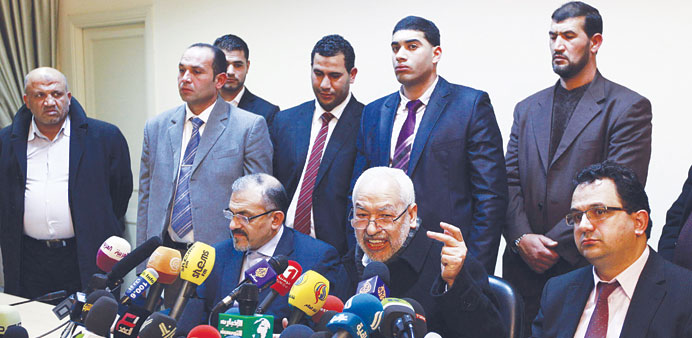
Ennahda leader Rached Ghannouchi speaks at a news conference in Tunis yesterday.