


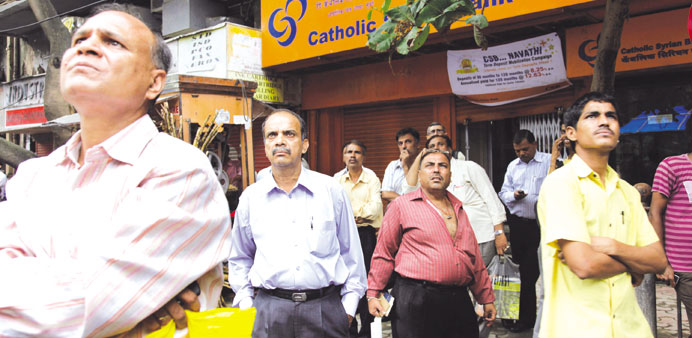
Pedestrians look at monitors displaying stock prices outside the Bombay Stock Exchange. Indian stocks fell yesterday with Sensex having its steepest weekly loss in a month.
Bloomberg/Mumbai
Indian stocks fell, with the benchmark gauge having its steepest weekly loss in a month, as faster-than-estimated inflation sparked expectations the central bank will raise interest rates in the coming week.
ICICI Bank, the country’s second-biggest lender, sank the most in almost 12 weeks yesterday. Bharat Heavy Electricals, India’s largest power-equipment maker, slid for a fourth day. Engineering company Larsen & Toubro lost 1.4%. The rupee weakened 0.6% against the dollar.
The S&P BSE Sensex retreated 1% to 20,715.58 at the close in Mumbai.
The gauge fell 1.3% this past week, its first drop in three weeks. Consumer prices rose 11.24% in November from a year earlier, data on Thursday showed, compared with the 10% gain analysts had predicted.
Most economists in a Bloomberg survey now expect Reserve Bank of India Governor Raghuram Rajan to increase the benchmark repurchase rate to 8% from 7.75% in a decision due December 18.
“The data is creating flutter in the market, and its influence will be seen as to what the RBI governor will say next week,” Gaurang Shah, assistant vice president at Geojit BNP Paribas Financial Services, said on Bloomberg TV India yesterday. “A 25 basis point rate increase is on the cards, but anything more will see more downside.”
Wholesale price inflation data for November are due to be released on Monday, December 16. WPI held unchanged at 7.0% from the month before, according to the median of analysts surveyed by Bloomberg.
Rajan has raised the main interest rate twice since he moved to the central bank in September to fight rising prices.
“We are very uncomfortable with the current level of inflation,’’ Rajan told reporters in Kolkata on Thursday after the CPI data were released. “We are aware of the weak economy, but we also have to take into account inflationary pressures.”ICICI Bank tumbled 4.2% to Rs1,085. State Bank of India, the nation’s biggest lender, dropped 1.9%. The 13-member S&P BSE Bankex decreased 2.3% to its lowest level since December 4. Housing Development Finance Corp, the biggest mortgage lender, retreated 2.4%.
Bharat Heavy Electricals sank 4.1%, extending this week’s loss to 9.8%, the most on the Sensex. Larsen & Toubro dropped for the fourth day after climbing to a four-month high on December 9. Tata Motors, the owner of Jaguar Land Rover, rallied 2.8% after tumbling the most since February on Thursday. Its 14-day relative strength index had fallen to 35 on Thursday. Some investors see readings below 30 as a signal to buy. For the week, Tata Motors declined 5.3%, its biggest drop in almost nine months.
The Sensex rose to a record on December 9 after the Bharatiya Janata Party won the state elections, giving it momentum to end the ruling Congress party’s decade-long rule in polls due by May and install Narendra Modi as prime minister. Modi is credited with achieving higher growth than the national average and increasing power capacity more than fivefold in his home state of Gujarat since becoming chief minister in 2001.
Global investors bought a net $160mn of local shares on December 11, taking this year’s inflows to $18.7bn, the most in Asia after Japan, data from the market regulator show.
The Sensex has climbed 6.6% this year, the best performer among the four largest emerging markets, and trades at 13.5 times projected 12-month earnings, compared with the MSCI Emerging Markets Index’s 10.4 times.