


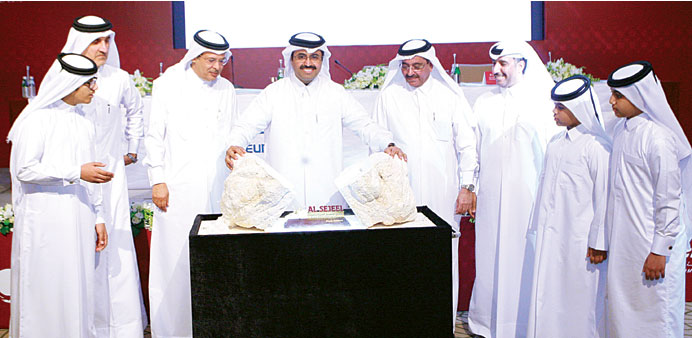
HE the Minister of Energy and Industry, Dr Mohamed bin Saleh al-Sada and Qapco chairman Hamad Rashid al-Mohannadi with senior QP and Qapco officials during the Feed contract awarding and logo launch of the $5.5bn Al Sejeel Petrochemical Complex at Ras Laffan yesterday. Right: Al-Sada with Maire Tecnimont Group CEO Pierroberto Folgiero and other senior Qatari officials following the Feed contract awarding to the Italian engineering major. PICTURE: Nejeer Feroke
By Pratap John/Chief Business Reporter
The $5.5bn Al Sejeel Petrochemical Complex at Ras Laffan, which is scheduled for completion in 2018, is unique in that it is the first mixed feed steam cracker in the country and the first one to produce polypropylene.
“Hitherto, all petchem complexes in Qatar were depending only on one feedstock. Now we are introducing a project with mixed feedstock,” Qapco vice-chairman and CEO, Dr Mohamed Yousef al-Mulla told Gulf Times in Doha yesterday.
“Through Al Sejeel Petrochemical Complex we are also introducing a product - polypropylene. It will be the first time we are producing polypropylene in Qatar,” al-Mulla said.
Besides, the complex is entirely owned by two Qatari companies – QP and Qapco.
“It is a 100% Qatari-owned company. And for a project of this scale and size, it is another first for us,” the Qapco chief said.
In addition to polypropylene, Al Sejeel will produce ethylene, high-density polyethylene, linear low-density polyethylene, butadiene and pyrolysis gasoline.
Asked whether there was any specific reason for designing the complex based on a mixed feedstock, al-Mulla said, “With advanced technology available today we can go in for a petrochemical complex with a mixed feedstock.”
He said more petrochemical projects in future could be based on mixed feedstock. The proposed Al-Karaana Petrochemical Complex at Ras Laffan will be one such; it will be an olefins and derivatives plant.
While Al Sejeel is a mixed feedstock of butane and naphtha, Al Karanaa will be based on propane and ethane.
Al-Mulla said polypropylene would have wide industry applications. It is in great demand across the globe.
He said Qatar may be able to consider manufacturing synthetic rubber in future since Al Sejeel will be producing butadiene. Butadiene is used for manufacturing synthetic rubber.
Al Sejeel plants will be processing several feed types simultaneously, such as ethane, butane, and naphtha, thereby ensuring an optimum use of natural resources and allowing extra flexibility and diversity in terms of products.
Qatar intends to raise its petrochemical output to 23mn tonnes per year by 2020, thus supporting the growth and diversification of the Qatari economy.
“By that time Qatar will be the second largest petchem producer in the Middle East after Saudi Arabia,’ al-Mulla said.
With its innovative mixed feed steam cracker, Al Sejeel will contribute to optimising the downstream value chain between gas availability as feedstock and market prices in high value-added hydrocarbon related products.
All products from Al Sejeel Petrochemical Complex will be marketed in high-growth regions in Asia, Africa and Latin America.