


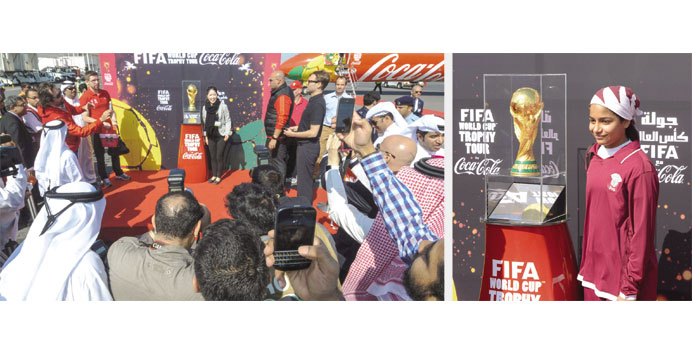
A fan poses next to the World Cup trophy following its arrival in Doha yesterday. (Right) Asma Ali Suroor, a young football player from Qatar, poses for a picture with the trophy. Pictures: Noushad Thekkayil
The lines spring out from the base, rising in spirals, stretching out to receive the world. From the remarkable dynamic tensions of the compact body of the sculpture rise the figures of two athletes at the stirring moment of victory.”
This was Milanese sculptor Silvio Gazzaniga’s description of his design of the FIFA World Cup Trophy.
The design, which was chosen among 53 submissions and depicts a globe resting on the shoulders of two athletes who have their arms stretched out, has survived four decades and still is the stuff of dreams for footballers across the world.
As Lekhwiya’s Algerian international Madjid Bougherra said, “It’s the best trophy in the world.”
The childlike excitement of Bougherra — who is one of the few footballers plying their trade in Qatar to have played in a World Cup — got the better of him when he said, “I have never touched it and I really want to.”
But the 31-year-old won’t be allowed to. Because he is neither a head of state, nor a previous winner of the World Cup — the only two kinds of people who have the privilege to touch it! “Touching it would mean a lot of hard work,” he realises.
The trophy has its own security detail, is being carried around the world in its own plane and travels in its own Louis Vuitton. The security guys handle it only after having worn a pair of gloves. It is placed in a transparent box with a mirror at the base of the paraphernalia to facilitate reading of the names of the winning teams which are inscribed at the base.
The secrecy around its maintenance and routine details is mind-boggling. But not surprising, given the history of its predecessor.
The Jules Rimet Trophy, which was named after the French lawyer who was the third president of FIFA and also the one who initiated the World Cup competition, was made of gold plated sterling silver and lapis lazuli, a deep blue semi-precious stone. It depicted Nike, the Greek goddess of Victory.
Apart from beauty, it also boasted of an adventurous lifetime. It was hid in a shoe-box under the bed of the president of the Italian football federation during World War II to keep it from the Nazis.
Two decades later, a few months before it was supposed to be presented at the 1966 World Cup in England, the trophy was stolen during an exhibition in London. While the search yielded nothing for a week, the world had a dog named Pickles to thank for finding it from under a hedge in south London. There was more adventure, the undesirable kind, in store.
FIFA’s rule of the time meant the team that won the World Cup thrice would have gotten to keep the trophy outright.
Brazil did, in 1970, and took the trophy home only to lose it 13 years later with thieves stealing the trophy from the offices of the Brazilian federation in Rio de Janeiro.
The Jules Rimet Trophy was never to be seen again, with police learning that the trophy had been melted for its gold. The Brazilian federation commissioned a replica and the new trophy was presented to the Brazilian president in 1984.
Gazzaniga’s creation, however, is FIFA’s property and the winning team is given a gold-plated replica for keeps. The base of the trophy has space for inscription of 17 winners, which means that it should continue to be around till the 2038 World Cup.