


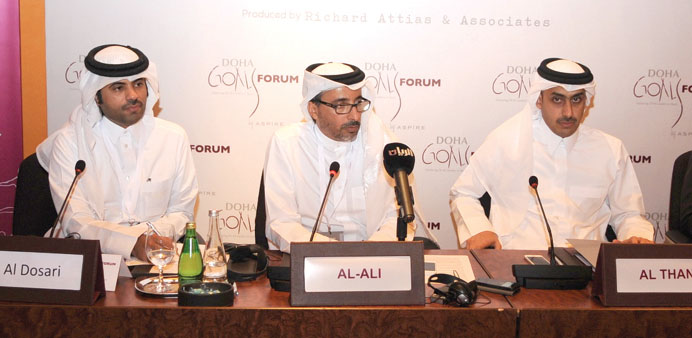
Qatar Stars League chief of commercial Abdulrahman al-Dosari, Qatar’s Minister of Youth and Sports HE Salah bin Ghanem bin Nasser al-Ali and Doha Goals executive director Sheikh Faisal al-Thani address the press conference after the Sports Ministers Summit here yesterday. PICTURE: Mamdouh
By Satya Rath/Doha
|
Can sports serve as a bridge to reduce the economic divide between developed and developing countries? If the power of sports is properly harnessed, can it help solve, at least to some extent, complex social issues such as gender and racial inequality? Can sports play a role in promoting innovation, economic growth, social inclusion and cohesion? Can sports be used as a tool to address political challenges such as disillusionment, unemployment and corruption? |
Those were some of the key issues which were discussed threadbare at the ‘Ministers of Sport Summit’, the highlight of the opening day’s programme in the second edition of Doha GOALS — a one of its kind platform for world leaders that seeks to address and advance social initiatives through sport — at the Aspire Zone yesterday.
The summit was chaired by HE Salah bin Ghanem bin Nasser al-Ali, Minister of Youth and Sports, Qatar, and was attended by sports ministers and representatives from countries like the United States, United Kingdom, France, Serbia, Oman, Tunisia, Dominican Republic, Libya, Sudan, Lebanon, Ivory Coast, Senegal, and the Republic of Congo, among others.
Leaders from the corporate world and private sector, as well as sporting icons like India’s Olympic gold medal winning shooter Abhinav Bindra, also served as guest speakers at the summit.
The delegates highlighted on the need to look beyond major competitions like the Olympics and World Cups and focus on the impact of sporting events of lesser profile, which, while not carrying the same weight as their bigger counterparts, can nevertheless play a big role in galvanising the youth in smaller and less-developed countries.
There was also a pledge to share more information between nations which can help in fighting corruption in sports. Creation and development of sporting infrastructure in less-developed countries was another topic that drew special attention, and Qatar, among others, stressed on the need to help such countries.
“Sport is all about solidarity. We want the lesser developed countries to do what Qatar has done, as far as sporting infrastructure is concerned. We would like to help such countries in building and developing sporting infrastructure. Equipments that would be used at the 2022 World Cup (in Qatar) can be dismantled and put to good use in those countries,” said al-Ali.
Involvement of private sector in digital infrastructure was another important topic of discussion. Technology plays a key role in any modern-day sport, and hence the need of the hour is to focus more on technological advancement which, the delegates felt, has the potential to contribute valuable insights to policy areas including health and urban planning.
The delegates also called on the G20 group of nations — particularly Australia, which will chair the G20 in 2014 -- to consider incorporating sport as well as the other themes that came out of yesterday’s summit within their ministerial discussions next year.
The Doha GOALS forum continues today and tomorrow at the Aspire Dome, with the launch of a new Centre of Excellence for Sports and Events Industries being one of the highlights of the second day’s programme.