


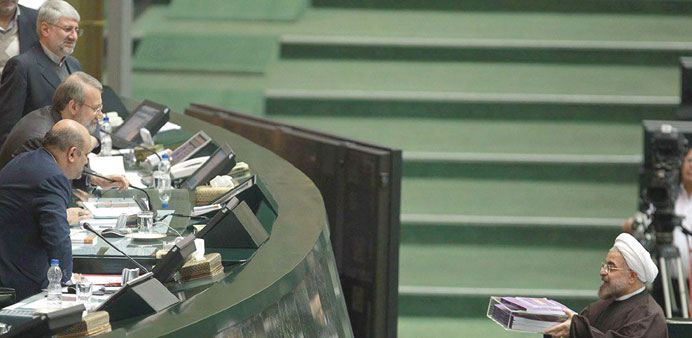
A handout picture made available by the presidential official website shows President Hassan Rohani holds budget papers to the parliament speaker Ali Larijani at the Iranian parliament in Tehran yesterday. Iran’s Inflation has soared for two years and productivity has slumped as ever tougher economic sanctions imposed to counter Tehran’s disputed nuclear programme have taken their toll.
Iran’s economy has contracted, says Rohani; vows to decrease inflation and create jobs; government spending earmarked at $66bn; new subsidies plan part of president’s agenda
Iranian President Hassan Rohani presented his first budget to parliament yesterday, vowing to bring down inflation and boost growth to lift an economy reeling from sanctions and what he says was mismanagement by predecessor Mahmoud Ahmadinejad.
Inflation has soared for two years and productivity has slumped as ever tougher economic sanctions imposed to counter Tehran’s disputed nuclear programme have taken their toll.
Rohani says Ahmadinejad squandered vast oil revenues on cash handouts and housing projects during his two terms in office from 2005 and racked up enormous government debt.
Gross domestic product had contracted by 6% over the past year, Rohani told lawmakers yesterday, while inflation was running at 44% when he took office in August, a situation he described as “very worrying.”
“Employment is the most important future issue for the economy but now the biggest problem is (tackling) stagflation,” Rohani said in parliament in an address shown live on state television. “The combination of stagnation and inflation over the past two years was unprecedented,” he said.
Rohani earmarked government spending for the year starting in March 2014 of $66bn, calculated on an open-market exchange rate.
The overall budget ceiling is estimated at about $265bn, Iranian media reported, leaving flexibility to lift spending depending on income received during the year.
Ahmadinejad’s overall draft budget ceiling for this year was about $200bn but it was never approved. In August, officials under Rohani indicated the spending plans faced massive shortfalls.
“The (Rohani) government has dared to present a 12-month budget and that’s a bit of a risk. He’s prepared to tell people what can be afforded but he’s also showing an element of financial discipline,” said Mehrdad Emadi, an Iran-born economist at Betamatrix consultants, based in Britain.
Ahmadinejad presided over a period of unparalled revenue growth due to high oil prices and was able to fund ever increasing budgets until Iran’s oil receipts were targeted by new sanctions at the start of 2012.
He also implemented reforms that withdrew massive subsidies on food and fuel in favour of direct cash handouts. Applauded in theory, it has been much criticised in practice.
Rohani indicated a new mechanism for subsidy payments would be put forward soon.
“The crucial battle will be over the subsidies bill. Rohani has to find a way of targeting those in need and that will be very difficult,” said Siavush Randjbar-Daemi, a lecturer on Iranian studies at Britain’s Manchester University.
Rohani secured a landslide election victory in June promising a policy of “constructive engagement” with the outside world would help ease international sanctions on the Iran imposed over its nuclear programme.
Iran denies Western accusations that it is seeking to develop nuclear weapons capability.
The draft budget estimates oil exports at about 1.1mn bpd, oil ministry website Shana said, indicating Tehran sees no major recovery in sales next year despite the prospect of limited sanctions relief.
Iranian media reported last week that the 2014 spending assumes an average oil price of $100 per barrel, about $10 below benchmark Brent crude prices. The International Monetary Fund expects Iran’s economy will shrink 1.5% this year in inflation-adjusted terms, after an estimated 1.9% contraction last year which was the biggest since 1988, when Iran’s eight-year war with Iraq ended.