


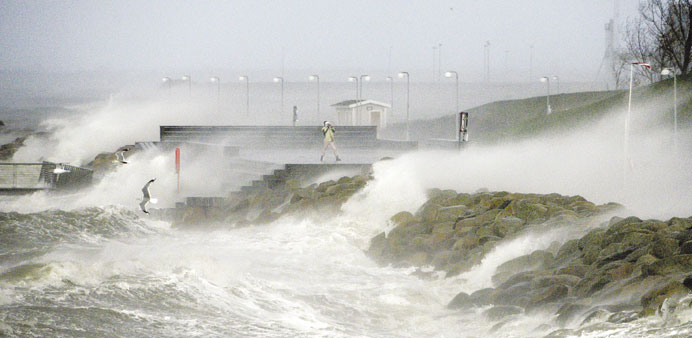
A man stands on the seafront in Malmo, southern Sweden. Winter storm Xaver, locally known as Sven, hit southern Sweden on Thursday night, claiming one life, littering roads with uprooted trees, stalling trains, and leaving tens of thousands without power.
Icy winter storms with hurricane-force winds yesterday lashed northern Europe, where the death toll rose while hundreds of thousands were left without power or stranded by transport chaos.
Emergency services across the region battled to evacuate flooded harbour areas, sandbag sodden dykes and repair damage from toppled trees that crashed onto houses, roads, train tracks and power lines.
Atlantic storm “Xaver”, having barrelled across Britain where two people died on Thursday, packed winds of up to 158kph as it lashed Germany, also battering the Netherlands, Poland and southern Scandinavia.
Blackouts hit 400,000 households in Poland and affected 50,000 people in Sweden and 4,000 homes in Germany, while thousands of air passengers were stranded as flights were cancelled at Amsterdam, Berlin, Hamburg, Gdansk and other airports.
The highest ocean swells in decades – brought by the strong winds and a large tidal surge – smashed into dykes in northern Germany and the Netherlands, which however reported no major breaches.
The total death toll rose further, with one man killed by a falling tree in southern Sweden, while three died in Poland.
“A tree crashed down onto a car on a local road” near the northern Polish town of Lembork, said firefighters’ spokesman Bogdan Madej.
Three people were killed. A woman was pulled from the wreck alive.
In Austria, a truck driver died when the storm pushed a bus into oncoming traffic in Salzburg province, and caused a multi-vehicle crash.
The previous day in Britain, a lorry driver died when his vehicle toppled onto other cars in Scotland, while an elderly man riding a mobility scooter was struck by a falling tree in Nottinghamshire, central England.
Also on Thursday, two Filipino sailors were swept overboard from a ship off southern Sweden and have remained missing, with the search called off and the two men presumed dead, while a 72-year-old woman died in Denmark after strong winds tipped over her van.
Despite the deaths and turmoil, affected countries breathed a sigh of relief yesterday that the damage wasn’t worse – mindful of catastrophic floods that hit North Sea countries in 1953, when more than 2,000 died.
Britain reported the worst tidal surge since that disaster, but Environment Agency spokesman Tim Connell told the BBC that “the defences seemed to have held up well”.
In northern Germany, the Elbe River harbour of Hamburg was under more than 6m of water – the second highest level since records were first kept in 1825 – leaving only the tops of lamp posts sticking out of the freezing waters.
Also in Hamburg, a fallen tree derailed a suburban commuter train which then struck a bridge post.
The fire brigade freed six passengers from the train, one with minor injuries.
In northern Schleswig-Holstein state, the emergency services were called out about 2,000 times, dealing mostly with road and rail accidents that left four people injured, and damage including roofs being ripped off houses and smashed windows.
At Cuxhaven in Germany, a 1,000sq m roof lifted off a building in the high winds, and damaged 40 cars.
Yesterday children in Germany’s storm-hit areas were given permission to stay away from school.
In snowy Berlin, hefty winds brought down the 13m-tall Christmas tree outside the residence of President Joachim Gauck.
Still, German authorities said the worst had been averted, compared to disasters such as severe floods in 1962 that left 340 people dead.
“Germany held its breath and looked at the dykes, and they withstood” the high seas, said the environment minister of Schleswig-Holstein, Robert Habeck.
“We are much better prepared today” than in 1962, Christian Herold of the meteorological service told AFP, with dykes higher and building design improved.
In Scandinavia, the Oeresund road and rail bridge between Sweden and Denmark was closed overnight but reopened early yesterday as authorities scaled down the alert level from the maximum 3 to 2.
In the low-lying Netherlands, defences withstood water levels that had reached their highest point since the floods of 1953, public broadcaster NOS reported.
In Britain the worst of the flood waters were receding, but with another two high tides expected later in the day, the Thames Barrier in London was set to be closed for the second time in two days in order to protect the capital.
Two trains derailed on the Danish island of Funen.
In addition to the fatal accident in Austria, another mass pileup of 30 cars closed down one of the country’s most important motorways near Linz, where heavy snow and sleet made the road slippery.
Each nation chose its own codename for the storm which had brewed in the Atlantic: it was dubbed Bodil in Denmark and Xaver in Germany.