


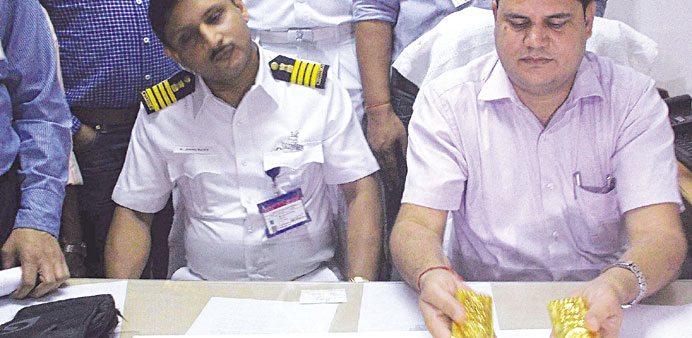
Indian gold smugglers are adopting the methods of drug couriers to sidestep a government crackdown on imports of the precious metal, stashing gold in imported vehicles and even using mules who swallow nuggets to try to get them past airport security.
Stung by rules imposed this year to cut a high trade deficit and a record duty on imports, dealers and individual customers are fanning out across Asia to buy gold and sneak it back into the country.
Sri Lanka, Thailand and Singapore are the latest hotspots as authorities crack down on travellers from Dubai, the traditional source of smuggled gold.
In a sign of the times, whistleblowers who help bust illegal gold shipments can get a bigger reward in India than those who help catch cocaine and heroin smugglers.
“Gold and narcotics operate as two different syndicates but gold smuggling has become more profitable and fashionable,” said Kiran Kumar Karlapu, an official at Mumbai’s Air Intelligence Unit.
“There has been a several-fold increase in gold smuggling this year after restrictions from the government, which has left narcotics behind.”
From travellers laden head-to-toe in jewellery to passengers who conceal carbon-wrapped gold pieces in their bodies - in the mistaken belief that metal detectors will not be set off - Indians are smuggling in more bullion than ever, government officials say, driven by the country’s insatiable demand for the metal.
That suggests official data showing a sharp fall in gold buying, which has helped narrow India’s current account gap, may significantly underestimate the real level of gold flows.
The World Gold Council estimates that 150 to 200 tonnes of smuggled gold will enter India in 2013, on top of the 900 tonnes of official demand.
Between April and September alone, India’s customs officials seized nearly double the amount of smuggled gold it nabbed in all of 2012.
“Though the quantum of seizures has increased, in our opinion it reflects only 1 to 2% of total smuggling,” said a revenue intelligence officer in Mumbai who declined to be named. “Dubai is still the number one place from where gold gets in and Singapore is slowly emerging. Sri Lanka has become a staging point.”
Grappling with a high trade deficit and weak currency, India imposed measures this year to crimp demand for gold, the second most expensive item on its import bill after oil. It imposed a 10% duty on bullion and a 15% tariff on jewellery. Imports plunged to 24 tonnes in October from a record 162 tonnes in May.
India has now stepped up co-operation with nearby countries to stem the smuggling.
Banks and other official trading agencies in Singapore and Thailand that had supplied gold to their Indian counterparts have stopped due to India’s new rules.
As customs officials at airports and borders get more vigilant, smugglers are innovating.
In June, a passenger flying from Dubai was caught at New Delhi airport with about 755g of solid gold staples painted grey. Officials stopped the man because the cardboard boxes he was carrying were stapled far more than seemed necessary.
In several other cases, travellers have been caught with gold in their underwear. Flight attendants and police officers have been arrested for aiding the smugglers.
“We are trying to plug all the loopholes. We have strengthened our anti-smuggling staff and installed door metal detectors,” said S A S Navaz, deputy commissioner of customs in Kochi. “We are spending sleepless nights.
“Most of the time, it is done with the support of (airport) staff. It is very difficult to keep an eye on everyone.”
In late November, 56 Sri Lankans were held in Kochi after they were found with nearly 12kg of gold. Some of them had travelled to Kochi six times last month.
Though the number of arrests made in India has increased, those that get caught are usually only the “carriers” who transport gold for as little as Rs10,000 ($160). The people behind the smuggling are rarely identified.
In an effort to change that, Mumbai customs offers a reward of up to Rs50,000 per kg of bullion seized for informers in gold smuggling cases. Cocaine and heroin informers get only up to Rs40,000 and Rs20,000 respectively.