


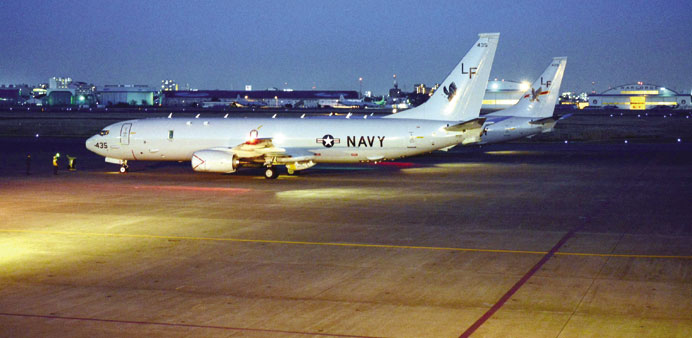
This US Navy handout image shows Patrol Squadron (VP) 16’s P-8A Poseidon No 429 and No 435 aircraft refuelling at Naval Air Facility Atsugi in Ayase, Japan. The US Navy has deployed sophisticated surveillance aircraft to Japan, officials said.
AFP/Washington
The US Navy has deployed sophisticated surveillance aircraft to Japan, officials said yesterday, amid rising tension over China’s territorial claims in the region.
Two P-8A Poseidon patrol jets departed Jacksonville, Florida on Friday and arrived later at Kadena air base in Okinawa, in a move that was planned before Beijing declared an air defense zone last month covering disputed islands in the East China Sea, a navy official said.
“This was scheduled for a long time,” said the official, who spoke on condition of anonymity. “It’s a rotational deployment.”
Four more Poseidon aircraft are due to deploy at Okinawa later this month, the official said.
The assignment to Japan marks the first mission for the new plane, which is replacing the propeller-driven P-3 Orion aircraft that dates back to the 1960s.
The P-8A planes, converted Boeing 737s equipped with advanced radar and anti-ship missiles, are designed to hunt submarines and track other vessels at sea.
On November 23, China announced an expanded air defence identification zone and said aircraft would have to submit flight plans before entering the area, home to disputed islands in the East China Sea.
Japan, South Korea, Taiwan and the US have each sent planes into the zone without informing the Chinese, signalling their refusal to recognise Beijing’s declaration.
After sending in two B-52 bombers last week, the US military has kept up “routine” military flights in the area but there has been no hostile response from China, Pentagon spokesman Colonel Steven Warren told reporters yesterday.
“The Chinese reaction to our operations has been normal,” Warren said.
“We haven’t changed our operational tempo,” he added.
The deployment of the P-8 aircraft came as US Vice President Joe Biden set out Sunday on a trip to Asia which will include a visit to Beijing, where he will discuss the spike in regional tensions.
Senior US officials said Biden would convey Washington’s “concerns” about China’s air defence zone and seek clarity regarding its intentions.
While military flights have gone ahead as planned, the US State Department has advised American commercial airlines to observe China’s demand for advance notice of aircraft entering the zone.
Biden arrives in Tokyo as Japan seeks support
US Vice President Joe Biden arrived in Tokyo yesterday, an AFP journalist reported, on the first leg of a swing through northeast Asia at a time of heightened regional tensions. Biden, who was greeted at the airport by new US ambassador to Japan Caroline Kennedy, will meet Japanese leaders today, as they will be looking for robust support in their increasingly bitter dispute with China over territory.
The visit, which will see Biden meet Chinese President Xi Jinping in Beijing before heading to Seoul and a meeting with President Park Geun-hye, comes just over a week after China declared an Air Defence Identification Zone in the East China Sea. It says any plane entering the zone, which covers the archipelago it contests with Japan, must file flight plans and obey its orders, on pain of unspecified “defensive emergency measures”. Japan, South Korea and the US have all disregarded China’s rules amid calls on Beijing for them to be retracted.
Analysts say in his meeting, Japanese Prime Minister Shinzo Abe will be looking for Biden’s fulsome backing for his position that China is being unreasonable and aggressive over the issue. But they point out that, while the US needs to reassure Tokyo, it must avoid going too far and angering Beijing or emboldening the hawkish Abe unnecessarily. In Tokyo today, Biden will also meet Abe’s deputy Taro Aso, as well as Crown Prince Naruhito.
He heads to Beijing tomorrow and to Seoul on Thursday.