


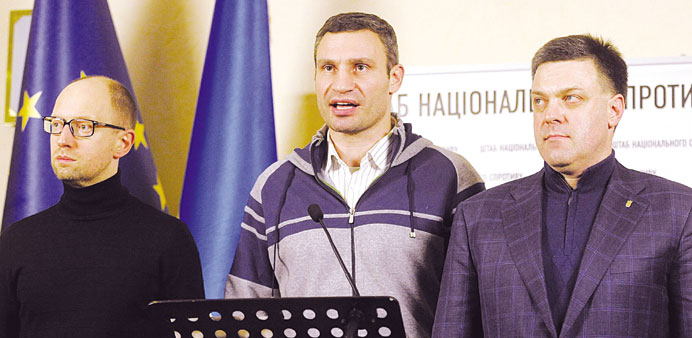
Tyagnybok (right), Klitschko, and Yatsenyuk (left) speak during press conference yesterday in Kiev.
At first glance, Vitaly Klitschko, Arseniy Yatsenyuk, and Oleh Tyahnybok, the three men that have together led the pro-EU protests in Ukraine over the past week, could not be more different.
But boxing champion Klitschko, former parliament speaker Yatsenyuk and nationalist Tyahnybok all found themselves spearheading the Kiev street protests in the absence of charismatic jailed former premier Yulia Tymoshenko, who led Ukraine’s “Orange Revolution” in 2004.
Klitschko, the 42-year-old heavyweight world champion who has said he will run for president in 2015, is one of the most popular figures in the former Soviet republic of 45mn people.
Towering at over 2m (6’ 7”) in height, Klitschko was an imposing presence when he urged protesters on Sunday to defy a court ban on protests.
“We must mobilise everyone across the country and not lose the initiative,” he told the crowd on the capital’s iconic Independence Square.
Known for his knockout punches on the ring, Klitschko aptly named his opposition party UDAR (which means “punch” but is short for Ukrainian Democratic Alliance for Reform) in 2010 and steered it to win 14 percent of the vote in last year’s parliamentary elections.
Nicknamed ‘Dr Ironfist’ by the sporting world, Klitschko grew up around the Soviet Union and in Ukraine but has also lived extensively in Germany where he has a residency permit.
He campaigned on an anti-corruption ticket and appealed to Ukraine’s desire to have a higher standard of living.
Arseniy Yatsenyuk, a trained lawyer, began his political career in 2001 as economy minister of the pro-Russian Crimean peninsula, but then pushed a pro-Western agenda after then president Viktor Yushchenko made him foreign minister in 2007.
Originally from the western town of Chernivtsy, 39-year-old Yatsenyuk was a compromise figure in the government when the conflict between Yushchenko and Tymoshenko began to spiral out of control.
Unusually for government officials in post-Soviet countries, Yatsenyuk travelled on regular passenger flights while in the top diplomatic post.
In late 2007 he entered Ukraine’s parliament, the Rada, later becoming its speaker, before going on to create his own party in 2009.
Running for president in 2010, he finished in fourth place with only 7% of votes and accused Tymoshenko of being in cahoots with winner Viktor Yanukovych.
However he declined an offer to head Yanukovych’s government, instead joining ranks with Tymoshenko’s supporters in 2012 and merging his party with her Batkyvschina opposition.
At the weekend protests, a defiant Yatsenyuk pushed for Yanukovych’s resignation, demanding that the parliament “immediately votes to dismiss the anti-Ukrainian government”.
Oleh Tyahnybok rose to prominence after scoring a surprise 10% in last year’s elections for his Svoboda (Freedom) party, a nationalist force accused of anti-Semitism, racism and homophobia by its critics.
A lawyer and surgeon by training, 45-year-old Tyahnybok is originally from the western city of Lviv where he became involved in 1991 in the Social-Nationalist party, which later became Svoboda.
On Sunday Tyahnybok accused the authorities of “provoking” violent clashes with protesters and declared that “a revolution is starting in Ukraine”.
Several Svoboda deputies stepped in at the weekend to man a protest headquarters at the Kiev City Hall after demonstrators stormed the building.
Vehemently anti-Russian, Tyahnybok has sought to emphasise Ukraine’s distinct cultural identity and regards the Soviet rule of the past as occupation of Ukrainian territory.
One pillar of Svoboda’s ideology is the glorification of the Ukrainian Insurgent Army (UPA) which fought against Soviet forces during WWII.
The Svoboda party had also organised a march against Hasidic Jews who arrive in their thousands for an annual pilgrimage in Ukraine.
His alliance with the moderate opposition of Klitschko and Yatsenyuk in the Rada sparked concern from Israel, but Tyahnybok argues that he is nationalist, not Nazi.