


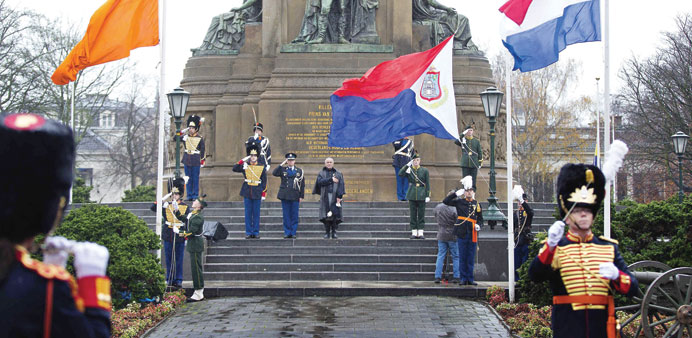
Dutch actor Huub Stapel (centre) portrays Prince Willem Frederik, later King William I, during a ceremony on Square 1813 (Plein 1813), for the celebrations marking the 200-year anniversary of the Kingdom of the Netherlands, in The Hague, The Netherlands. William returned from his exile in England as a hero on November 30, 1813. His landing marked the independence of the Netherlands from the French and the beginning of the United Kingdom of the Netherlands.
AFP/The Hague
Thousands of people braved cold and rainy weather in The Hague yesterday to kick off festivities marking the 200th anniversary of the founding of the modern Dutch state.
Actors staged a re-enactment of the November 30, 1813 arrival of Prince Willem Frederik – later King Willem I, the ancestor of current King Willem-Alexander – at a Hague beach, followed by pomp and ceremony at the official opening of the celebrations at a mediaeval hall near the Dutch parliament.
“Today, 200 years ago in 1813, the seed was sown for what would later become the Kingdom of the Netherlands,” King Willem-Alexander said in a speech at the historic Knights’ Hall, which stands cheek-by-jowl to the Dutch parliament in The Hague.
“Happy birthday,” Dutch Prime Minister Mark Rutte added, saying that November 30 marked the official birth of the modern Dutch constitutional monarchy.
Prince Willem Frederik’s 1813 landing at the beach at Scheveningen, today a popular seaside suburb, is widely seen as setting in motion the formation of the modern Dutch state.
The prince arrived there after 18 years in exile under French rule, which ended with Napoleon Bonaparte’s defeat at the Battle of Leipzig a month before, in October 1813.
Napoleon’s loss resulted in the destruction of much of what was left of French power in the Netherlands, Germany and Poland.
Prince Willem Frederik was crowned as King Willem I of the united Netherlands in 1815.
“Today we are celebrating what we’ve achieved over 200 years,” Rutte said.
King Willem-Alexander, who took over from his mother, Princess Beatrix, in April this year and attended the ceremony with his wife, Queen Maxima, was presented a commemorative book.
An orchestra played a song composed for the occasion.
King Willem-Alexander remains the head of state, but the country is today ruled by decisions made by parliament.
The bicentennial celebrations will continue on various dates over the next two years, ending in September 2015 in the Dutch capital Amsterdam, organisers said.
The calendar includes festivities on Saint Martin, which together with Curacao and Aruba forms part of the Kingdom of the Netherlands in the Caribbean.