


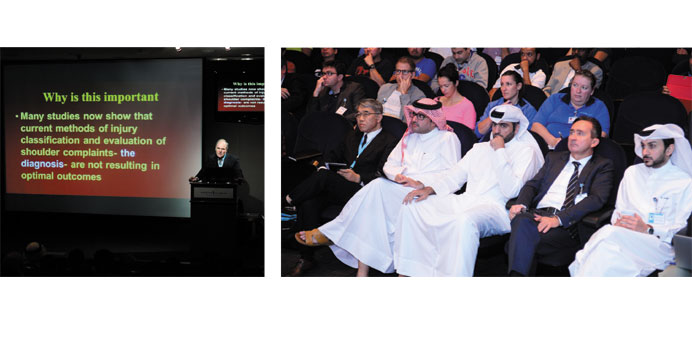
Dr Kibler giving a presentation. Right: A section of participants at the conference.
The current methods of injury classification and diagnosis are proving ineffective to the treatment of shoulder injuries in throwing athletes, experts warned at the ‘Current Concepts’ conference under the theme: ‘The Athlete’s Shoulder’ that concluded recently at Aspetar Orthopaedic and Sports Medicine Hospital.
Founder and medical director of the Lexington Clinic’s Shoulder Centre of Kentucky Dr Ben Kibler, who spoke on ‘Standardised Shoulder Examination in the Overhead Athlete’ at the two-day gathering, said: “Many studies show that the current methods of injury classification or diagnosis are now proving to be ineffective, because the diagnosis of something like a labral or bicep tear, for example, doesn’t actually tell you anything about the outcomes.”
Kibler discussed the notion that shoulder injuries can actually be caused by a problem occurring elsewhere in the bodies of throwing athletes such as tennis players, baseball pitchers and swimmers.
“The body works and fails as a unit because it is a closed chain, and if there is a dysfunction in one area it has an effect on the entire kinetic chain,” he explained adding: “Therefore, it is important to compile an entire list of problems the patient has when you examine someone who comes into your office with a shoulder injury.”
The compilation of such a list, he added, can be achieved through a series of simple physical motion tests, whereby patients are asked to stand on one leg or do half squats for example.
Their ability or inability to perform such tasks effectively is telling of the root cause of the shoulder injury, Dr Kibler said.
His theories offered delegates new perspectives for treating shoulder injuries which, according to Aspetar acting chief medical officer and National Sports Medicine Programme (NSMP) executive director Dr Hakim Chalabi, embodied the philosophy of the Concept Conference and the hospital.
Explaining the Aspetar ethos during the symposium, Dr Chalabi said: “It is important for us at Aspetar to have experts who have not only the highest expertise in sports medicine but also a profound understanding of sport as well. Our main medical strategy at Aspetar is clinical care, where we aim to maintain a premier clinical pathway with the knowledge attained from different schools of sports medicine. This allows us to take various approaches to sports injury management by adopting the best methods from each part of the world.”
The two-day Concept Conference was developed by Aspetar as a platform for sports medicine experts to share the latest advances in the management of sporting injuries, specific to certain areas of the human anatomy.
Past conferences have focused on the athlete’s knee, ankle and elbow.
This year, in-depth lectures, panel discussions and interactive seminars unearthed shoulder pathology and cutting-edge treatments available to throwing athletes, once again offering delegates interactive opportunities with the world’s leading experts.
More information about the conference can be had at http://www.aspetar.com/CurrentConcepts2013