


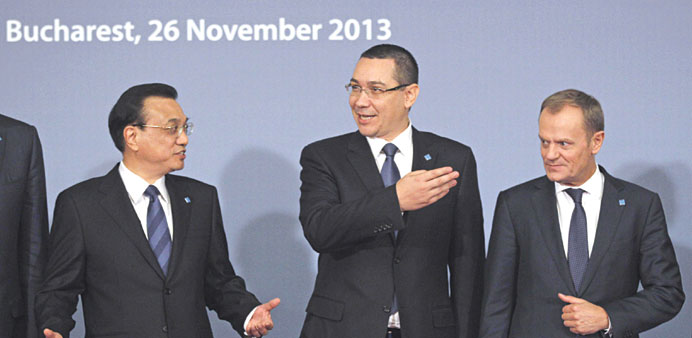
From left: China’s Premier Li Keqiang, Romanian Prime Minister Victor Ponta and Polish Prime Minister Donald Tusk gesture during a family photo after the meeting of heads of government from Central and Eastern European countries and China in Bucharest yesterday.
China eyes co-operation in infrastructure, communications, high-speed railway projects, which will lead to massive investment and a rise in commercial exchanges
China and 16 Central and Eastern European countries pledged yesterday to boost two-way investment and trade, insisting that EU regulations will be met.
“China eyes co-operation in infrastructure, communications, high-speed railway projects, which will lead to massive investment and a rise in commercial exchanges,” with countries in the region, Chinese Prime Minister Li Keqiang told 16 CEE counterparts and hundreds of businessmen attending a meeting in Bucharest.
“We are prepared to discuss ways to finance these projects, within the lines traced by European Union regulations,” Li stressed.
Brussels has warned countries in the region against crossing any regulatory red lines when concluding economic deals with China.
Li said he hoped $10.5bn in credit lines committed by China last year would be put to use, proclaiming 2014 “the year of China-CEE investment and business ties”.
The credit lines were announced by Li’s predecessor Wen Jiabao during a summit in Warsaw.
But analysts say that 18 months later the promise the massive capital injections have yet to materialise.
The gathering in Bucharest comes less than a week after the 28-nation European Union held a summit with China at which the two sides launched negotiations for a landmark investment agreement.
The EU and China have seen their commercial relationship grow dramatically but also witnessed increasing trade disputes over issues ranging from solar panels to wine.
“Pragmatic cooperation between the CEE region and China is beneficial not only to the two sides but also to the consolidation of balanced development in Europe as a whole,” Li stressed.
“China needs a powerful Europe, but Europe can only be strong if each and every one of its members attains rapid economic development,” Romanian Prime Minister Victor Ponta said.
The prime ministers of 15 Eastern European states are attending the summit. Latvia is represented by its Foreign Minister.
On Monday, shortly after arriving in Romania, Li insisted “co-operation between China and the CEE was an important part in the relationship with the EU.”
He added that China wanted “a strong euro currency and a united, prosperous EU.”
China and Romania signed 13 cooperation agreements on nuclear, renewable and conventional energy, and on agriculture.
The accords on nuclear co-operation are expected to give China General Nuclear Power Group (CGN) a role in Romania’s plans to build two new reactors at its sole nuclear plant, at Cernavoda.
The project, delayed for years for lack of funding, is worth more than $5.4bn. Ponta made a point of reassuring Brussels, stressing that Romania would “definitely observe the EU competition rules.”
But he added that Chinese companies should not be discriminated against “when their bids were technically and financially better, which was the case in many fields.”
Li and his Hungarian and Serb counterparts, Viktor Orban and Ivica Dacic, also announced an agreement on the modernisation of a railway linking the two Central European countries.
“This will be a landmark project,” Li said.
Orban hailed a “one-of-a-kind, never-before agreement,” saying it embodied a “win-win-win-win situation, as Serbia, China, Hungary and the EU will all have to gain from it.”
“China’s investment policy is of assistance to the entire EU because it increases the competitiveness” of the European bloc, he added.