


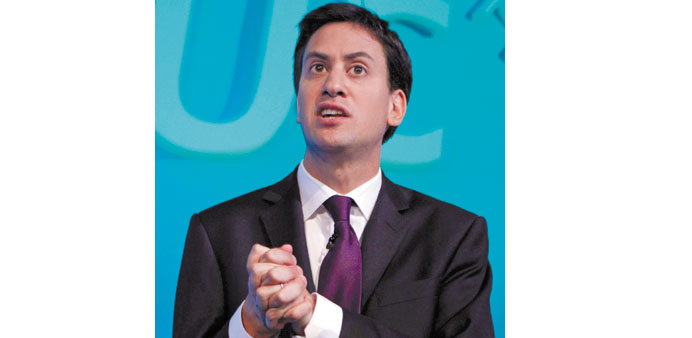
Ed Miliband’s relationship with his elder brother David is only just “healing”, the Labour politician revealed yesterday.
In a more emotional and intimate interview than he has given before, the opposition leader talked to Desert Island Discs host Kirsty Young about underestimating the pain caused by his decision to stand against his brother for the top job in their party, and about his recent anger at newspaper attacks on his late father, the Marxist academic Ralph Miliband.
In a BBC Radio 4 performance that attempts to underline his status as a normal bloke - although he admits he was too “square” to attract a girlfriend at university - Miliband’s luxury item is a weekly chicken tikka masala from his local north London Indian takeaway.
He also resorts to a number of “cheesy” hit tracks from his youth, including A-ha’s Take On Me, for comfort on those lonely island nights. The Hitchhiker’s Guide to the Galaxy, by Douglas Adams, is his choice of reading material. His father’s death was, he says, “the worst thing that has ever happened to me”.
“He was a lodestar. I didn’t agree with everything he said, but he was a point of reference.”
Miliband chooses two or three tracks that remind him of his father, including Paul Robeson’s socialist anthem, The Ballad of Joe Hill.
Miliband’s parents, both Jewish refugees, shared a love of Britain, he tells Young, despite the Daily Mail’s claim that his father was unpatriotic.
“The reason I hated that so much is because it was so much at odds with the way my parents felt about this country.”
His mother, Marion Kozak, was five when war broke out and she hid in a Polish convent before being taken in by a Catholic family. Her father was killed in a concentration camp and she came to Britain on her own.
Miliband understands, he says, the public’s interest in the family background of political leaders: “You can’t understand me without understanding where I come from. In modern politics who you are, and who your family is, is always going to be relevant and important to people. It comes with the territory.”
National interest in the family stepped up when Miliband stood against his brother for the leadership in 2010. His mother did not ask him not to stand, Miliband reveals, but simply told him to do what he felt was the right thing.
Asked by Young if he talked about the decision with his brother, he replies: “Not really. We had conversations. They were quite elliptical. Neither of us was desperate to confront it, I suppose. We didn’t have a sort of total heart-to-heart about it.”
He eventually beat the brother he had once described as his best friend by 1.3% of the vote, due to strong union support. “Is he still your best friend?” asks Young. “Yes, but it has been incredibly tough. I didn’t take the decision lightly. I knew it would have an impact; on my family, on him.”
Admitting that it is possible he underestimated the family trauma his move would cause, Miliband says he did it because he felt he had “got things to say, or things to do that I am in a better place than him, or others, to say and do about the way we need to move on from New Labour”.