


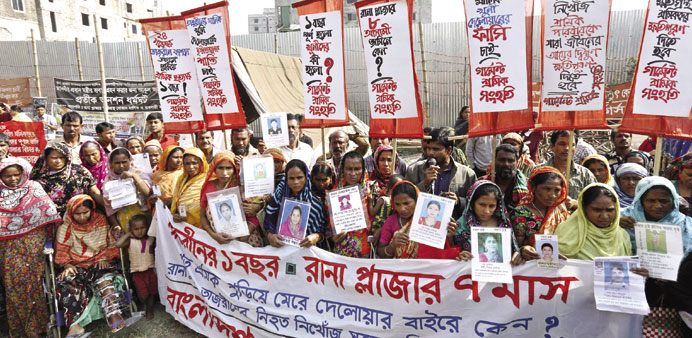
Relatives holding photographs of the dead and missing garment workers of the Rana Plaza building collapse during a rally to mark the seventh month anniversary of the building’s collapse, in front of the Rana Plaza site in Savar, near Dhaka, yesterday.
Bangladesh police said yesterday they plan to charge the owner of a garment factory over a fire that killed 111 people as they wrap up an investigation 12 months after the tragedy.
Police officials said charges would be laid against 15 people including owner Delwar Hossain, security guards and managers over the fire that swept through the Tazreen factory that supplied clothes to Western retailers including Walmart.
“Delwar and his wife, who is the co-owner of the factory, are going to be charged with causing death due to negligence,” Monsur Ali Mondol, a police investigator of the case, said.
The fire — which broke out exactly 12 months ago — on the outskirts of Dhaka was the country’s worst industrial inferno and shed an international light at the time on the appalling safety conditions of the country’s $22bn garment industry.
“Our investigation is almost complete. We’ll soon press the charges against around 15 people,” said A K M Mohsinuzzaman Khan, another police inspector investigating the case.
The tragedy was dwarfed by an even bigger disaster months later in April at the Rana Plaza garment factory complex also on the outskirts of the capital which collapsed killing at least 1,135 people.
Factory owners are rarely charged over such tragedies in the sector, which is a mainstay of the impoverished country’s economy, accounting to up to 80% of the Bangladesh’s exports.
The Tazreen factory owner, who has since the tragedy been barred from leaving the country, has been accused of breaching construction rules including building staircases that were too narrow and unsafe.
Mid-level managers and security guards have been accused of preventing workers from leaving the seven-storey factory when the fire was small and confined in the ground-floor’s warehouse, Mondol added.
The victims, mostly women who were paid as little as $37 a month, found themselves overcome by smoke or jumped from elevated windows.
Factory disasters are common in Bangladesh, home to 4,500 garment factories, where four million workers sew clothes for the world’s top retailers and brands.
The country is the world’s second largest apparel exporter after China.
This month the government raised minimum wages for workers by 76% and launched inspections of factories in the wake of mounting criticism that authorities were failing to improve the sector.
The new wage of $68 a month still makes Bangladesh one of the worst paid garment sectors in the world.
Meanwhile, at least 50 people, including three firefighters and policemen, were injured yesterday in clashes that erupted after thousands of Bangladesh garment workers attacked a fire station in Savar on the outskirts of Dhaka.
Eyewitnesses said the workers vandalised 10-12 vehicles and went berserk following a brawl with some firemen, reports Xinhua.
According to police and eyewitnesses, a bus carrying garment workers of a factory damaged a footpath in front of the fire station while taking a U-turn in the morning.
As a fireman shouted at them, the workers got off the bus and got locked in a brawl with the fire officials.
Spurred by rumours that a female garment worker was tortured by the firemen, thousands of workers from nearby factories rushed to the scene and attacked the fire station, eyewitnesses said.
A police official said the agitating workers entered the fire station and smashed all window panes and furniture, leaving three officials injured.
He said huge street clashes erupted when police arrived and tried to disperse the crowd by firing rubber-bullets and lobbing tear-gas canisters. The worker looted office equipment and torched a motorcycle and two vehicles of the station. The workers then blocked a highway and damaged many vehicles.
Clashes once again broke out when police tried to evict the workers from the highway to lift the blockade.
The agitating workers claimed that some of their female colleagues were manhandled by the firemen.