


Rain has finally fallen in Doha. It started on November 17, which is a lot later than last year when we saw a rogue shower on September 28, but you know what they say, “better late than never”!
Although it was a decent amount of rain for Doha, in actual fact we only had a few millimetres. That didn’t stop many of the roads flooding and the resulting puddles took several days to dry up completely.
There are a number of reasons why the puddles remain in Doha for such a long time, and not only because there aren’t many drains! The water simply doesn’t soak into the soil here like it does in other parts of the world. The lack of vegetation and the sandy soil baked hard by the sun make the surface virtually impermeable. The rain simply sits on the surface of the soil and forms huge puddles until it eventually evaporates.
The conditions in Somalia are very similar to Qatar, neither location can cope with vast quantities of rainfall. This is why it was such a disaster when a tropical cyclone slammed into the coastline of Somalia on November 10.
The amount of rain seen from this cyclone was over 200mm (8 inches) in places, and I struggle to imagine the amount of damage that 200mm of rain would do in Doha.
The fact that Somalia has a similar climate to Qatar is surprising given how close Somalia is to the equator. Qatar is on a comparable latitude to the African Sahara Desert, the Indian Thar desert and the Chihuahuan Desert in North America, and therefore it could be expected that Qatar is a desert.
However, Somalia is further south than you would expect a desert to be. If you look on a map, it’s on a similar latitude to very lush locations, including Sri Lanka or the central Philippines.
The Horn of Africa isn’t the tropical paradise that it might be thanks to the winds that that are established in the summer months. These winds cause a cold current to well up near the coast, and this suppresses the rainfall. The cold waters ensure that even though the prevailing wind direction in the country is from the sea, the sea is so cold that not much water evaporates into the air above it; therefore, not many showers develop. It’s the same effect that is seen in Lima, Peru, which is the driest capital city in the world even though it’s on the coast.
Unlike Peru, however, Somalia is at risk of being hit by a tropical cyclone. For such a dry country, which is so ill-equipped to deal with major rain events, this can be devastating. Fortunately, it is rare and has only happened on four other occasions since weather satellites were first used: in 1984, twice in 1994 and in 2012.
The north of Somalia is the driest part of the country, where much of the Puntland region has an annual rainfall of less than 100mm (4 inches) like Doha. This was the region worst hit by the rain from this year’s cyclone. The cyclone wasn’t actually very strong; the winds were only 72kph (45mph) which means it was only the equivalent of a tropical storm, but the amount of rain was a major problem.
One of my colleagues is from Somalia, so before the storm made landfall, I asked him if he had any contacts in the town of Eyl, in Puntland, where the eye of the storm was forecast to strike. I was hoping for a photo sent on a smartphone, but he laughed. He explained that it was a small place, without any electricity, and a photo would be impossible.
Somalia is a country that has been torn apart by civil war since the collapse of the central government in 1991. This instability has ensured that the people are generally very poor. The basic housing offered little protection against the storm, and the lack of communication in the region also worked against the residents by ensuring that there was minimal warning of the impending storm.
As you might expect from such a remote part of the world, the effects of the storm did not make the headlines immediately. As well as hitting the wrong part of the world to make headlines, it also hit at the wrong time, striking Somalia just one day after Typhoon Haiyan caused catastrophic damage in the Philippines.
Eventually, the news of the destruction in Somalia started to filter through to the outside world. The storm had killed over a hundred people and destroyed entire villages and crucial transport routes. For those who survived, life has become even more of a struggle, with many wells contaminated by flood water and thousands of livestock swept away.
My hope for those living in the region is that the next cyclone will not hit Somalia for many years to come.
(The author is Senior Weather Presenter at Al Jazeera English channel. She can be contacted on [email protected]
or on Twitter at @WeatherSteff)
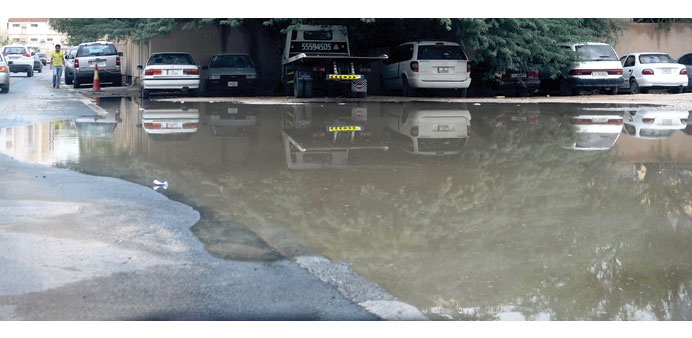
Up against it: Puddles of water formed after the rain in Doha. These remain until the water evaporates, which takes quite a while. Photograph: Shem