


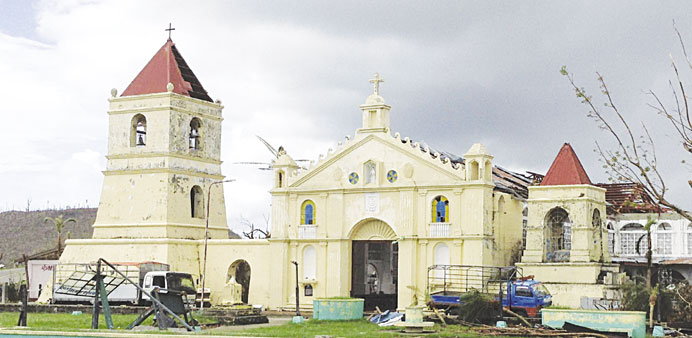
A view of the Roman Catholic church and belfry in the coastal town of Balangiga devastated by super typhoon Haiyan.
Reuters/Balangiga
In the devastated coastal Philippine town of Balangiga, a Roman Catholic belfry with a maroon steeple rises from the rubble, a battered symbol of resistance for a people with mixed feelings about the US military now helping them survive.
US military helicopters are now flying in aid to desperate regions such as this once-picturesque fishing village of 12,600 people in ravaged Samar province.
It was here 112 years ago that one of the darkest chapters of American colonialism began: the island-wide massacre by US soldiers of thousands of Filipinos, including women and children, in response to the killing of 48 US soldiers by rebels.
Animosity has festered for more than a century over the ultimate insult: seizure of the town’s church bells by US troops.
In recent years, the Philippine government has demanded their return.
Marciano Deladia, a chief aide to the mayor, and other residents are thankful for the US packets of rice and other food. “But we want our bells back,” he said.
The town built the belfry in 1998 in the hope that the US would return three bells it says were stolen as trophies during the 1899-1902 Philippine-American War.
One is believed to have been rung to signal the start of the attack. Two of the bells are at the Warren Air Force Base in Wyoming. The third is part of a travelling museum now at a base in South Korea.
The dispute over the Balangiga bells underscores the difficulty the US will face in transforming goodwill over its aid to typhoon victims into a bigger military presence on the ground in the Philippines.
Although the two countries are close allies, mistrust still lingers over America’s previous role as colonial master, as well as its longtime support for the brutal and kleptocratic regime of the former dictator Ferdinand Marcos.
The belfry is among just a few buildings still intact after Super Typhoon Haiyan killed 14 people in Balangiga, where a well-organised evacuation plan kept fatalities low.“We don’t have any animosity against the American people,” said Deladia, standing in front of a monument recreating the ambush of US troops. But the bells, he said, are “part of our historical heritage”.
Every Sept 28 the town re-enacts the 1901 Balangiga “incident” in which 48 occupying US soldiers died in an ambush at the old church that triggered the brutal retaliation.
Gregoria Pabillo, 76, said replacement bells, which are rung every day at noon and 6pm, lack the “rich sound” of the originals, which according to legend could be heard two towns over, some 20km away.An official at St Lawrence the Martyr Parish Church, which stands on the site of the 1901 ambush, said retrieving the bells was important for a full accounting of the past.
“Some people say ‘what’s the big deal with the bells?’ To that I say: why is it such a big deal that you have to keep the bells?” said Fe Campanero, a secretary at the church.
But even if the US wanted to return the bells, it seems it is restricted by law, at least for the next few years.
Lieutenant Colonel Jeffrey Pool, a Pentagon spokesman, said the bells and “other memorial artifacts” were subject to legislation prohibiting their return.
“Specifically, the law is: Prohibition on Return of Veterans’ Memorial Objects without Specific Authorisation in Law,” he said. The section on the bells expires in 2017. It wasn’t immediately clear what would happen then.