


AFP/Tokyo
The Bank of Japan (BoJ) yesterday held off announcing any fresh measures to stimulate the economy, saying it was “recovering moderately” and that efforts to stoke inflation were taking hold.
The bank’s decision, after a two-day meeting, to hold steady on monetary easing comes despite a sharp slowdown in growth in the July-September quarter that raised questions about the strength of the country’s recovery.
The BoJ unveiled its vast asset-buying scheme in April as part of a broader plan by Prime Minister Shinzo Abe to reinvigorate the economy and eradicate deflation with a policy blitz dubbed Abenomics.
“Japan’s economy has been recovering moderately,” the bank said in a statement.
“The year-on-year rate of increase in the CPI (consumer price index) is likely to rise gradually.” Reversing years of falling prices is a key goal of the BoJ’s easing plan, which aims for 2% inflation in two years. Analysts, however, have been increasingly sceptical of that ambitious timeline.
The bank has been ratcheting up its economic growth outlook, with its most recent forecast predicting an average 2.7% expansion in the year to next March, with inflation at 0.7%.
Inflation is tipped at 1.9% within about two years, the BoJ said last month.
Last week, official data showed economic growth halved year-on-year in the July-September quarter as exports weakened and consumer spending slowed.
The BoJ yesterday also acknowledged possible headwinds from overseas but said it remained optimistic.
“We are taking a half-step forward on our assessment of overseas economies,” BoJ governor Haruhiko Kuroda said.
The effects of the US government shutdown last month on the world’s largest economy were limited, the BoJ chief said, adding that “the US ... pace of growth is expected to accelerate going forward”.
However, in its statement earlier yesterday, the bank warned “the prospects for the European debt problem ... and the pace of recovery in the US economy” remained concerns.
The central bank added it was still open to further easing measures for Japan’s economy if necessary.
“We will examine both upside and downside risks to economic activity and prices, and make adjustments as appropriate,” it said.
Analysts have been warning that Tokyo’s bold programme - a mix of big government spending and central bank monetary easing - is not enough on its own to stoke lasting growth without promised economic reforms.
Critics of Abe’s policy say growth so far is largely thanks to stimulus spending and the BoJ’s injections of vast sums of money into the financial system, similar to the US Federal Reserve’s quantitative easing.
Some analysts argue the BoJ will have to usher in more monetary easing at some point to shore up Tokyo’s efforts.
Bank of Japan Governor Haruhiko Kuroda said the US and eurozone economies are gaining strength, seeking to dispel concerns among other policymakers that Japan’s export engine and broader recovery were vulnerable to weakness overseas.
He was also optimistic about the prospects of the central bank meeting its inflation target, suggesting that any additional monetary stimulus would be some time away given the expected recovery in exports and firm household spending.
“The outlook is brightening somewhat due to a recovery in the US and Europe. We have slightly upgraded our view of overseas economies,” Kuroda said. “We were worried about the US fiscal standoff, but the impact has been very limited. We expect the US economy to pick up pace as downside pressure from that fiscal situation eases.”
His comments came after the BoJ, as widely expected, maintained the massive monetary stimulus put in place in April, under which it aims to achieve 2% inflation in roughly two years by doubling base money through asset purchases.
Japan’s economy slowed in July-September as exports and household spending moderated, although analysts expect growth to accelerate in the current quarter as consumers try to beat a sales tax increase next April.
Soft exports have been a key concern for BoJ officials, who hope the global economy will pick up to make up for an expected downturn in household spending after the sales tax rise.
While a modest rebound in export volume in October may have tempered such concerns, pessimists in the BOJ’s nine-member board had warned of sluggish growth in emerging Asia.
The BoJ’s previous board meeting in October revealed the biggest rift since Kuroda launched his stimulus campaign in April, as three members dissented against the central bank’s rosy outlook for achieving its price target.
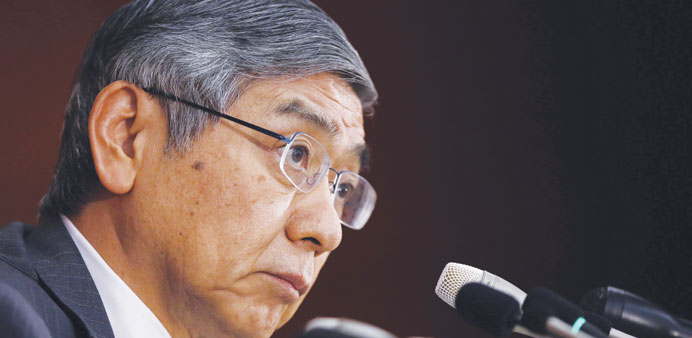
Kuroda listens to a reporter’s question during a news conference at the BoJ headquarters in Tokyo yesterday.